Introduction
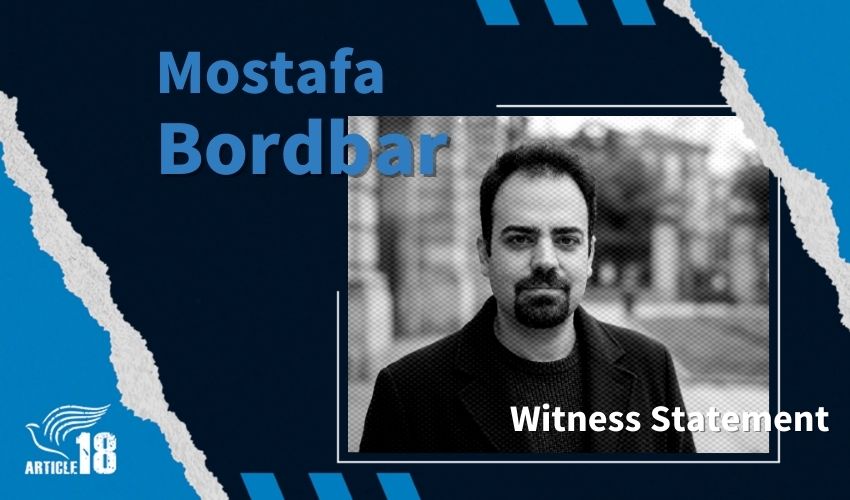
1. My name is Mohammad Hadi (Mostafa) Bordbar. I was born in 1986, in Shiraz. I was a teenager, maybe 14 or 15 years old, when I had a car accident and near-death experience and felt like I heard God’s voice telling me He would give me another chance. I couldn’t walk for six months, but when I went out for the very first time after those months, I saw a bookseller beside the street. There was a green book there, a New Testament, and I felt like it was supposed to be mine, so I bought it.
2. When I started to read it, I thought it had been falsified. Nonetheless I got to a point where I said: “Jesus, you’re alive. Be my guide and lead me to the living God who can speak to me.”
3. After that, many times in my sleep or even while awake, I felt an urgency to go and ask people in the church in the city where I lived, Rasht, who Jesus Christ was. This urgency became so great that one day I finally went and rang the doorbell and asked my question. The church member I spoke to went and spoke to the pastor, then came back and asked me to go and come back in 40 days. He told me: “Re-read the New Testament during this time!” But I didn’t return to that church for a long time. Instead, I went to different places to seek God. I researched and studied different religions and many viewpoints, and even went to a dervish monastery and became a dervish. During that time, I also met a Christian who had converted from Islam. We talked and discussed spiritual matters together. After hours and days of discussing with each other, I finally understood and accepted the truths of the Bible to some extent; although I still didn’t consider myself a Christian. I was still going to the dervish monastery at that time. The first dhikr [recitation] that the sheikh had given me was to be repeated more than 100 times between each prayer. It was a quote from Jonah in the belly of the fish, taken from the Quran, which said: “O Allah, forgive me, for I am the most sinful of sinners.” One day, about two years after the accident, when I started repeating this dhikr after the noon prayer, I heard the same voice of God that I had heard before, this time telling me: “I have forgiven all your sins.”
4. So I converted to Christianity in 2006 and from the first year of my conversion, I became involved in Christian activities in my house-church. The first church I attended was a house-church in Rasht in the private home of a Korean person. There was a network of Korean missionaries inside Iran at the time, who had several churches in several cities.
First arrest
5. In the year 1388 in the Iranian calendar [2009], massive demonstrations erupted in several cities as people protested widespread fraud in the presidential election. It was after two or three months of that election, and the widespread protests in the summertime, when the government decided to put more pressure on Christians as well. Somehow, whatever happens in the country, the government persecutes Christians!
6. Our house-church group was the first to be arrested that year [according to the Iranian calendar]. I think it was mid-summer when they arrested us. A Korean friend, who was the head of our network in Iran, was also arrested. He was living in Tehran, but at the time of the arrest was in Rasht.
7. The Korean missionaries were threatened by the security and judicial forces, and were accused of espionage, but weren’t charged officially. After a while, they had to leave Iran. They were told informally to leave Iran by themselves; otherwise they would be deported. So the Korean missionaries decided to leave Iran to avoid being deported. After leaving, they started Christian activities in other countries and are still active in this way.
8. The day I was arrested, I had been leading a house-church meeting and, after leaving that place and turning on my mobile phone, realised I had received several calls from my family. Then, in a phone call with my sister, I learned that intelligence agents had gone to our house and taken my computer, all my books, CDs, DVDs, and everything I had, and then had written the address of the intelligence detention centre on a piece of paper and given it to my family, instructing me to introduce myself there.
9. So about a day or two later, I reported myself to the intelligence detention centre. It was a Saturday morning, and the rest of our house-church members had already been arrested, together with the Koreans. When I introduced myself, they said: “Where have you been!” They started interrogating me that same day, but didn’t tell me what I was accused of. Instead, they decided to start interrogating me and then to decide what accusation they would like to bring up. That’s a normal way of dealing with Christians inside Iran. So I was taken for interrogation and then, without any official accusation being declared, I was sent to a solitary cell.
Lakan Prison
10. I was in solitary confinement at the intelligence-service detention centre from Saturday until Thursday. And every day they would take us to different rooms for several long hours of interrogations. On the first or second day, at night, they took me and another Christian to the main prison of Rasht, Lakan Prison, where they registered our names and took our fingerprints and pictures. Then they took us back to the detention centre. Separately, the intelligence officers at the detention centre also took us all to a room, gave each of us a sign with numbers on to hold, and took our pictures from the front and side.
11. When I was being interrogated, the officials brought out a typed text and read it. It said: “I called Mostafa and I said, ‘Where are you?’ And Mostafa laughed and said: ‘I’m already on the way!’” It was clear that they had listened to our phone calls and had written them down. They tried to make us think badly of the Christian whose words they were reading and make us believe that one of our house-church members would leak information. But I had already done many things together with this particular Christian, which the intelligence service didn’t know, so I knew the officials only wanted to play with our minds and make us think badly of each other.
12. Thank God, they didn’t torture me physically, but of course they did mentally. They threatened me in various ways, including that they would completely deprive me and my family of our social rights, or even execute us for apostasy. During interrogations, I sat blindfolded in front of a wall. From underneath the blindfold, I could just see enough to be able to write things down. After a few days, they brought us all together for an interrogation, and this time they told our Korean friend, Lee, that he was a spy! The accusation they made against us Iranians was that of apostasy. That day, the interrogator shouted at us: “We’ll execute you in this very yard!” We said: “We are just Christians! But if we have to be executed, then execute us!” This answer upset him even more, and he called someone, then sent us back to our cells.
13. On the Thursday, they sent me and another Christian to Lakan Prison, to a ward with other prisoners who’d committed various crimes. Then they allowed our families to post bail for us, but because it was the weekend we had to stay in prison until the Saturday.
Pastor Vruir
1ً4. The week after our release I went to see Pastor Vruir [Avanessian]. Pastor Vruir was my spiritual mentor and coach. He was an Iranian-Armenian, who for 28 years had ministered at the Assemblies of God Church in Tehran, but then had resigned apparently due to health issues. But in fact, his main reason was that he had wanted to serve the underground house-churches and Persian-speaking believers who had been excluded from attending church. After speaking and praying together, we decided that I would continue my trips to Tehran, while leading the house-church in Rasht quietly and only with completely trusted people.
15. I went to Pastor Vruir’s house almost every week, travelling to Tehran from Rasht. This bus ride took about four or five hours. We would meet in person at 9am on Saturdays, and in the afternoon our house-church meetings would be held in Tehran with the rest of our active church members. Then, in the evening, I would return to Rasht for my pastoral work, leading house-church meetings and prayer walks, which we usually held early in the morning, at 6am.
First release
16. By the time of my release, the Koreans had already left, and our members had been scattered. During our detention the intelligence service had also tried to instil in us the feeling that somebody among our house-church members was a spy of the Ministry of Intelligence (MOIS) and had leaked information to them.
17. Because of my family being involved in theatre and TV, and I was involved as well, we were used to going to some governmental places, such as the Drama Association, the Artistic Sect of the Islamic Republic, and the Guidance Department. And it was normal at those places that there were intelligence-service agents and religious people. But we had to go anyway, because of being involved in art. And because I was going to these places, it gave some of my friends the idea that “Mostafa, who goes to such places, must be that spy who is among us!” However, I continued my activities of establishing churches, pastoring, and evangelism in Rasht and elsewhere quietly, without telling others what I was doing. My activities also expanded to other cities, and I established churches in various places, such as Karaj, Shiraz, Isfahan and Rasht.
18. In Rasht I started a house-church, which gathered in the park in the mornings. Every morning, at six o’clock, two or three people would gather in the park and pray. And that was the beginning of this house-church group in Rasht. Those few people, after only five months, at Christmas-time, had become around 30 people.
19. One day, the intelligence service decided to call all of us Christians who had been arrested, just to follow up with us and check if we were doing something wrong or not. They called every once in a while, just to let us know that they were watching us and that they were aware of our activities, but that was actually a lie, and they were just pretending that they knew everything.
House-churches
20. In 2011, an activity that was added to my list was when one of my friends, who had focused on different cities, asked me to support the leaders in different Persian-speaking churches; so cities like Qom were added to those to which I travelled, and I supported the leaders of the house-churches there. Until 2012, my activities continued in different cities, and I was maybe only in Rasht for one week a month and spent the other three weeks in different cities.
21. Then we ran out of Bibles. We used to go to the Persian-speaking churches that existed at that time – the Central Assemblies of God Church and Emmanuel Church – to buy Bibles and Christian literature. But the security forces were putting pressure on the Protestant churches at that time, counting the Bibles in their stores and threatening the churches not to provide Bibles to Persian-speaking people. So the churches were wary, and when we asked them for Bibles, they could no longer give us any.
22. I had to contact my Christian friends who had emigrated abroad and ask for help. It wasn’t possible to acquire Gospels and Bibles except by smuggling them into the country. The first time my friends tried, they informed us that there had been a problem with the delivery and that the cargo had been discovered. But the second time, the cargo, which included 7,000 Gospels, made it through and I travelled with a friend to the meeting place to pick them up. On our way back, we noticed that we were being followed by a motorbike, but with great effort, we managed to lose them. Hundreds more Christian books, DVDs, and Bibles were also delivered to me soon after. At that time, I had rented a small room in Tehran so that I could stay there when I went to Tehran. And this room became a warehouse for Christian books and Bibles. The following week, my contact called again and said that they had 5,000 Bibles in stock and wanted to give them to us. It was as if they were going to empty their entire warehouse for us! I gladly accepted and sent many of these books to various places that needed them. But storing nearly 5,000 Bibles and other Christian books didn’t leave me much room to sleep!
Second arrest
23. At Christmas-time 2012, we held our Christmas party two or three days after Christmas, ahead of New Year’s Eve. During this party, which we held in the Rasht countryside, myself and my wife Gilda announced our engagement and the members prayed for us, and all seemed well with the world.
24. The next day, we were together with Rev Vruir at a Christmas celebration in Tehran, where there were around 50 to 60 people, and I was sitting beside Pastor Vruir.
25. In the middle of the party, while I was talking with Pastor Vruir, the doorbell rang and around 20 people in plainclothes, all wearing surgical masks and carrying walkie-talkies, raided our celebration. They separated the men from the women, telling the women to put on their headscarves, and we were told to sit down on the chairs they directed us to. The lady who was the host of the party had hired someone for the celebration, to serve tea and sweets, and when the intelligence-service agents came, it was like they knew him, because they didn’t do anything to him. He just stood there in the kitchen, looking at us.
26. I was in a state of shock as they started filming us and writing down our names. When the officer who wrote down our names came to me, and asked what my name was, I answered: “Mostafa”. As soon as he heard my name, he shouted: “Haji! Haji! Mostafa is here!” Later on, this Haji, who had a black beard, was my aggressive interrogator. He told me: “Mostafa, come here!” I told one of the people next to me: “Please pray for me; it’s the second time I have been arrested.” It became clear that they had also expected Gilda to be at that party, to arrest her too, but she wasn’t there when they came.
27. That night, they arrested Pastor Vruir because they considered him the leader of the house-church, and they arrested me because of the Bibles. The others had to fill out forms regarding who they were, and to answer some questions. Then they took Pastor Vruir in one car to his house, and they took me in another car to my room in Tehran.
28. As I sat in the car, I could hear them talking on their walkie-talkies, and they were talking about the second floor. It was clear they already knew my address, so I didn’t try to pretend I lived elsewhere, but when we entered the building, I pretended that the ground floor was what I considered the first level, and that the first floor, which was my friend’s apartment, was the “second floor”, and I took them inside that apartment, since I had the key. My hope was that in this way I could prevent all the Bibles, Christian books, and DVDs from being discovered. I opened the door, and during their search they found two or three Bibles and said: “Where are the rest!” I said: “Just today and yesterday, I gave them all away.” So they didn’t find any of them, and then they took me straight to prison. So the day after my engagement, I was taken to Evin Prison.
Evin Prison
29. That night, after searching both mine and Pastor Vruir’s homes separately, they took us to Ward 480 of Evin Prison, which was the solitary confinement ward of the MOIS. First, they gave us very thin prison clothes, and we changed into them, and then on that cold winter night, they kept us both in the yard for many minutes, and we shivered with the cold. Finally, they came and took us to separate rooms for interrogation, so that very first night, the interrogations and threats began. From the very beginning, they asked me to tell them about the 12,000 Bibles that they seemed to know I had received but which they had not been able to find. In order not to endanger anyone, I tried to give them general answers, saying only that I had given them away to various people, and that they had all now gone. After several hours of interrogation and repeated threats, they sent me to solitary confinement, a very small cell with a toilet, which at times emitted an extremely unpleasant odour.
30. Every day, they came to take me and Pastor Vruir out of our cells and into the interrogation rooms. To do this, we had to come out of our cells and wait by our cell doors, blindfolded, facing the wall. Then, since Pastor Vruir had recently fallen and hurt his knee, and was limping, he would put his hand on my shoulder, and together we would slowly walk down the stairs, blindfolded, to the interrogation rooms. The interrogations lasted hours, and they tried to find charges to justify our arrest, using words and phrases to describe members of our house-church or Christianity as though they were facing a formidable and well-organised political group. After a few days, Pastor Vruir was no longer there, and I later learned that they had had to release him on bail due to his ill health. Prior to his release, they had taken us to the prosecutor’s office, where the investigator, without explaining our charges, had issued a temporary-detention warrant for us, and then we were returned to our cells. Finally, after 10 days of solitary confinement, they sent me to the MOIS’s Ward 209, where I was placed in a cell with several other prisoners charged with various crimes. After a few days, most of the other prisoners were moved, leaving only myself and one other political prisoner, who was kept with me to try to convert me to Islam.
31. During the time that I was in Ward 209, they interrogated me every five days. In between those sessions, I rehearsed the story I was going to tell them of how I had managed to get rid of so many Bibles. I had to come up with a story to protect the books and some of the people who had received them, and I had to make sure I never forget the story I told. So, for five days I repeated this made-up story to myself, to ensure that when I told it, it would seem as though I was telling the truth, and at the same time make sure I didn’t tell them where the Bibles actually were. I still had 3,000 or 4,000 Bibles in my room!
32. During the first two months of my detention, they interrogated Gilda for several hours at the Rasht intelligence detention centre, pressuring her to tell them where the Bibles were. Even though I wasn’t sentenced for another six months, they threatened her that: “We want to sentence Mostafa to 10 years!” They also asked her: “So, do you still want to wait for him?” She answered: “Yes, because I believe God wants me to marry him.” Then they threatened her again.
33. Another Christian who had been present at the Christmas celebration, named Mikael*, was also involved in receiving the Bibles with me. He was one of my friends and co-servants in the house-church, and the intelligence service knew that at the time I had picked up the Bibles, he was with me. So I spoke about Mikael and other things I knew that they already knew. Firstly, I had to make them believe I was telling the truth; secondly, they already knew about the connection between me and Mikael; and thirdly, I knew Mikael was a tough person and wouldn’t be broken by them easily.
34. Once, without me realising, they brought Mikael to the interrogator’s room in Ward 350, where I was sitting in front of a wall, blindfolded, and asked me: “Where are those Bibles?” I said: “I don’t know! Ask Mikael. He knows.” They said: “Mikael doesn’t accept this.” I said: “OK, he doesn’t want to accept it, but I gave them to him; he took them.” Although I knew where Mikael had put the Bibles, I didn’t tell them. Then the interrogator told me to turn around, and as I turned around, I saw Miakel. He said: “Yes, I know Mostafa, I saw him in the church, but I didn’t take anything from him.” I said: “Well, I gave the Bibles to him.” But Mikael insisted on not having received them. So the intelligence service never found those Bibles and couldn’t understand which of us was telling the truth.
35. After 26 days of detention and interrogations, the intelligence service discovered that I had given them the wrong address, and that I had taken them to my friend’s apartment. They found this out because they had taken my friend for interrogation, and although he had no intention of betraying me and didn’t even know his room had been searched, he just happened to mention, under pressure from the interrogators, that: “I don’t know anything – Mostafa lived upstairs, and I don’t know what he did in his room.” So in this way, he unfortunately and unintentionally leaked information that there was an upstairs room, which I used.
36. So on that same day, they triumphantly gave me my clothes and said: “We are going for an operation!” I was scared and thought they might even be going to execute me. But, in fact, a team of agents took me to my house, and that’s when I found out that they had learned about my real room, and knew where the rest of the Gospels were. My friend was there too and they forced us to carry all the boxes of books down ourselves, which we did on our shoulders. Then they put the Gospels and everything else related to Christianity in the car. It was very heartbreaking, and I said this to them when I was interrogated again later. They asked why I hadn’t told them that I’d had those books, and I answered: “Because in the news, I’ve heard and read that you burn these books. And because this book [the Bible] is holy for us, and is the book of our faith, so I didn’t want it to be burned.” Then they told me that now I must give them the correct account of how I had distributed the Bibles. So again I had to come up with another story to provide them with safe and uncompromising information, and to somehow save the remaining thousands of Bibles that had not yet been discovered.
37. I later found out that the day after my arrest, the incident had been reported by international media. Pastor Vruir was well-known, and many people had advocated for him. He was an Armenian, and he was also sick – every two days he had to go for dialysis – so the intelligence service couldn’t hold him for too long, as they were extremely afraid of the negative consequences of his arrest being covered by the media. That’s why he had been released on bail after about 10 days.
38. Given the international sensitivity surrounding Pastor Vruir, I also knew that I could say to the intelligence service that the books I had received had been for Pastor Vruir, as he was an official pastor, and that they weren’t for me. However, I tried not to reveal information about Pastor Vruir’s other activities – those the MOIS wasn’t aware of.
39. As already mentioned, for 10 days I was in a solitary cell and after that, for 50 days I was in a shared cell in Ward 209 known as a “suite”. And after the other prisoners there were transferred, the person who remained with me in that cell was a known member of the Green Movement [a political movement that began after the 2009 election fraud], who was a Muslim and tried to convert me to Islam. For 50 days, he read the Quran loudly and memorised it. He shouted verses from the Quran as part of his protest. I felt like I had been placed in that suite on purpose and I was going mad! I decided to do something like a hunger strike, but it was more like fasting. I refused to eat solid food for 20 or 21 days, and said: “Now that you want to convert me to Islam, I would rather die and hand over a Christian corpse to you than convert to Islam!”
40. Then, after not eating for 20 or 21 days, and having been detained for 60 days in total, they sent me to Ward 350 of Evin Prison, which compared to solitary confinement and the suite was like heaven to me, because Farshid [Fathi], who was a Christian leader, and several other Christians were there, and had a Bible. They had a secret MP3 player as well, so I could listen to worship songs. It was like heaven. The first night I slept there, I put the Bible under my head and fell asleep, desperate to make sure it wasn’t taken away from me.
41. Another active Christian who had been a friend of mine for several years, and we had served together – Ebrahim Firouzi – was also brought to Evin. They had arrested him in Robat Karim [just south of Tehran], at his house-church, but he had talked to the prosecutor and said: “I have some Christian friends in Evin. Would you please, now you are sending me to prison, send me to Evin?” The prosecutor agreed, and so Ebrahim was brought to Evin.
42. During all the persecution I had experienced, the toughest thing for me was that I didn’t know what my sentence would be. Finally, on 9 June 2013, after I had been interrogated severely, threatened, and prevented from posting bail, the verdict of the court was issued. Judge Pir Abbasi, head of Branch 26 of the Revolutionary Court, sentenced me to five years for each of the two charges against me – a total of 10 years. I was convicted of “consensus and collusion with the aim of committing crimes against national security”, and “membership of an anti-security organisation [house-church],” under Articles 499 and 610 of the Islamic Penal Code. My lawyer was a human-rights activist. Her name is Shima Ghusheh, and she was a colleague of Abdolfattah Soltani – a very famous lawyer in Iran, who was imprisoned in Evin at the same time as us. He had been sentenced to imprisonment for his participation in the establishment of the Defenders of Human Rights Centre (DHRC).
Court
43. After several months, my lawyer was told that my case had by mistake been sent to the wrong appeal court – the 34th branch – for which an independent judge was responsible. When Soltani heard about this, he said: “OK, so you will be free, or at least your sentence will be reduced, because that judge is a good man and is trying to clean up some of the mess-ups that they made in the past.”
44. On 30 October 2013, which was a Wednesday, my appeal-court trial took place. Those present were the judge, Mohammad Taghi Salimi, his assistant, Seyed Ali Asghar Kamali, and myself and my lawyer, Shima Ghusheh. The judge listened to me. He was a very open man, even to Christians. He accepted me as a Christian, and after 10 months’ imprisonment, he decreed that I should be acquitted and released from prison. In the ruling, he wrote: “The appellant denied the alleged crimes at various stages of the trial, and his activities were in line with his religious beliefs, and there is no evidence in the case that indicates that his actions were against the existence of the Islamic Republic regime and the security of the country.”
45. On Saturday, only three days after the court hearing, my release letter was sent to the prison. My lawyer had told me that it would take at least a month, or even one and a half months, to do all the paperwork, but on that Saturday morning my release letter arrived at the prison.
46. Later, I found out that the intelligence service was shocked by the letter. So, when they found some misspelling in the letter, they decided to send it back to the court, just to buy some time for themselves to find some more evidence or create some new case against me. But the letter was sent back again the very next day, so the intelligence service had to release me.
47. I was standing beside the exit to Ward 350, where the officer responsible for comings and goings at the prison was waiting for my belongings to be checked and then for me to be escorted out of the ward with a soldier, across the courtyard of Evin Prison to the exit door, when the officer was suddenly called. The head of Ward 209, Haj Mozaffar, was on the line and asked him: “Where is Mostafa?” The officer answered: “Mostafa right now went out with the soldier.” But I was actually still there. When he hung up the telephone, he told me: “The head of Ward 209, Haj Mozaffar, was looking for you. Just go! They are trying to find something against you; just get out!” It was shocking for me. So I hurried towards the exit with the soldier, just to make sure I would get out of prison and be released. It was 3 November when I was finally released. Some of the prisoners were worried that perhaps my release was only a hoax and that the intelligence service intended to kidnap me outside of the prison and make me disappear. For that reason, some of them had given me their family’s phone numbers, so that if I really was released, I could call them and tell them that it was real and that I was really free.
After release
48. About 10 days after my release, Farshid, who was still in Evin Prison, secretly called me and said: “Mostafa, whatever you do, just leave Iran! We heard they are preparing a case against you to send you back to prison!” With the help of a Christian friend of ours, who had a friend who worked at the airport, Gilda and I checked to see if I was banned from leaving. He reported back that he couldn’t find any information to indicate that I was banned from leaving, but that if there were security charges against me, he wouldn’t be able to see them. So Gilda and I decided to leave by the Bazargan land border, as soon as possible, by bus.
49. There was a checkpoint before the border, where the bus dropped us off, and after getting off, we were taken to a room by a border guard, who practically interrogated us. Finally, he allowed us to continue our journey, but when we reached the border, and after our passports were stamped and we were about to cross, the officer’s phone rang, and after talking on the phone, he told me that “you are banned from leaving”. We were taken to another room, and there another officer showed us a piece of paper that said: “Mostafa Bordbar’s departure from the country is a threat to national security.” I said in surprise: “But I have been acquitted and my case is closed!” The officer replied: “They must not have had enough evidence against you; that’s why you were released. Now they are preparing more evidence.” Then he took Gilda’s laptop from us to find more evidence. He also took my passport from me. Then he searched our belongings for other possible evidence. Finally, we had to accept that we couldn’t leave Iran and had to return home on that cold and snowy night. We were emotionally broken, and experienced a new trauma.
50. After that incident, my lawyer went to the court to pursue my case. The authorities told her: “You are no longer Mostafa’s lawyer.” According to my lawyer, this could only mean two things: either a new case had been opened against me, or they just wanted to intimidate and harass me. But since I had been banned from leaving, and my passport and laptop had been taken, it was clear that a new case had been opened against me. As a result, we decided to try to leave Iran as soon as possible, before any further harassment and persecution could occur.
51. Firstly, Gilda left the country. She travelled to Malaysia under the pretext that she was a student of a university in Malaysia, so that she could have an excuse if there was a problem at the airport. Then she travelled to Turkey from there. Then I tried to flee. For six days, I was at the border. Finally, one day, while I was at the smuggler’s home, I felt God wanted me to remain in Iran, so I prayed: “God, my wife is in Turkey. We spent all we had!” My father had sold his car just to raise the money so I could leave Iran. Gilda’s father also supported us, but we had spent most of the money we were given. So I told God that I would stay one more night, and wanted Him to show me by then whether I should stay in Iran.
52. That same night, when the smuggler returned, he told me: “I don’t know who they’re after, but every night the border is open and there are about 200 to 300 travellers waiting to cross, but when they call me to bring my traveller, a Toyota from the MOIS is nearby, waiting for the person they want to cross.” In effect, he was indirectly telling me that “they’re after you!” I knew that if I was arrested while leaving Iran illegally, the intelligence service would have a good reason to prove whatever they would like to prove against me. So I decided to pay another sum to the smuggler to let me return to Tehran, and I asked my wife to return home too. This was very hard for her, and very hard for me. It was another trauma for us.
53. Six months after I first discovered that I had been banned from leaving the country, I went to the passport office in Rasht to ask about my passport. By this time, Gilda and I had re-established our house-church, but we were trying to use safer methods. Anyway, that day, together with my brother and a friend of ours, we went to the passport office, and after a long wait, the deputy director finally told me to go to another office, which was following up on my case. I knew this office was under the supervision of the intelligence service and thought to myself that they were sending me there with malicious intent, so when we arrived, I sent my brother in instead. He went in and said “I’m Bordbar”, and they immediately cuffed his hands and a soldier started filling out a personal information form for him. My brother gave the same details as I would have done, until he got to the marital section; then he said: “I am single and Mostafa is married. I am Mostafa’s brother!” The intelligence-service agents, hearing that, were really mad at him. My brother also told me that some intelligence-service interrogators had been there, as well as a soldier from the prison.
54. They clearly wanted to arrest me, and for some hours they threatened my brother and talked to him while he was handcuffed, before allowing him to leave. They told him: “Tell Mostafa to come to us tomorrow morning at eight; otherwise we’ll go to his house.” I didn’t go, so one week later they came after me, but I didn’t open the door. After they left, my wife and I ran away again and this time went to Shiraz, without even telling our families where we were.
55. After two months in hiding, God showed us that He would bring us out, like Paul in the basket, at midnight. And in the summer of 2014, I was finally able to leave Iran, over the mountains. I didn’t have any more money, so one of my friends kindly paid all the expenses for the smuggler. And, finally, after a very tough night, I arrived in the city of Van in Turkey.
56. After about 10 days, Gilda joined me in Turkey, and it was a great relief for both of us to be in Turkey.
0 Comments