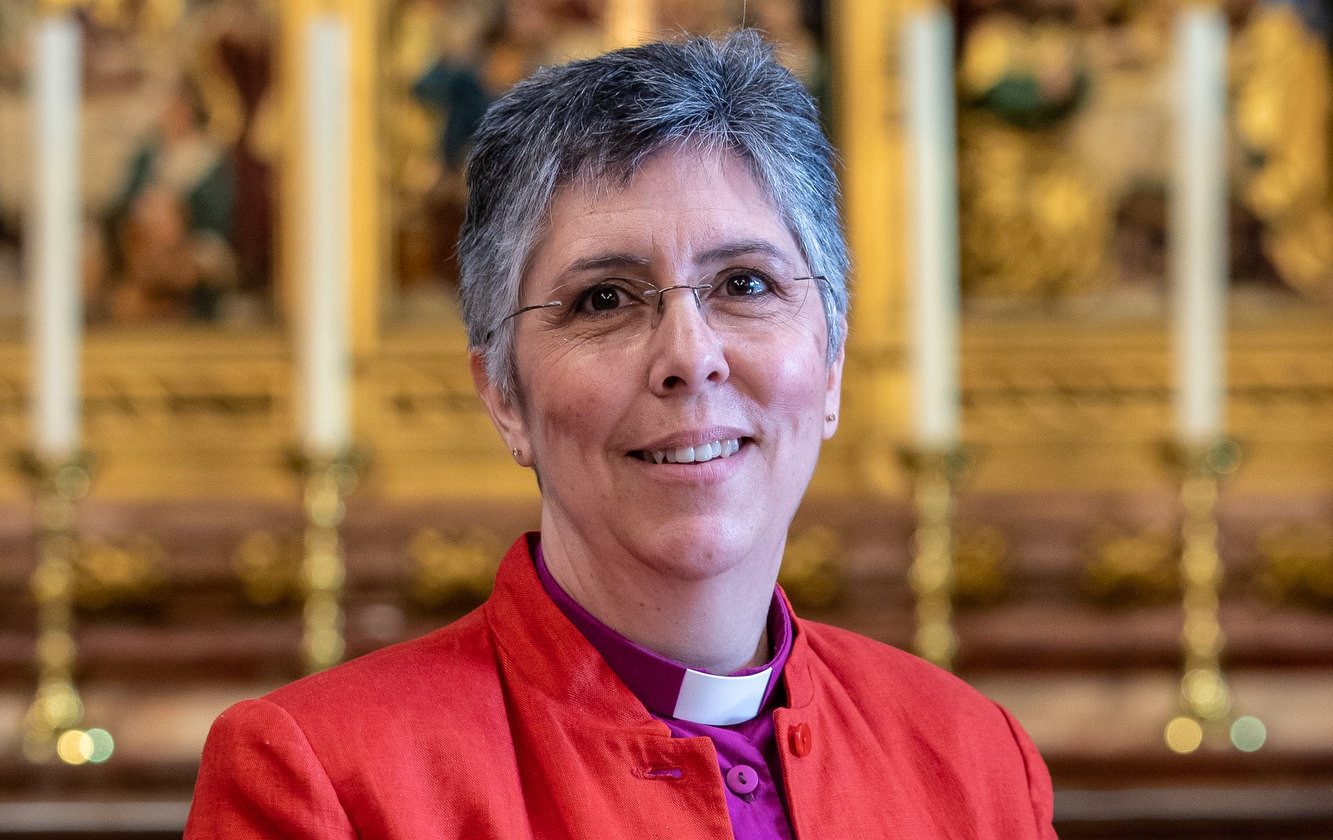
An exchange between a British-Iranian bishop and a group of Iranian Christians in the UK has shed light on the different ways in which Iranian Christians have responded to the current conflict.
The exchange was prompted by a letter that Bishop Guli Francis-Dehqani, the daughter of the first Persian Anglican bishop of Iran and sister of a martyr of the Iranian Church, Bahram Dehqani-Tafti, wrote to The Telegraph on 4 March, in which she argued that the war was “unjust and illegal”.
The bishop was herself responding to an article in The Telegraph by a British peer, Lord Biggar, who had known Bishop Guli’s brother from his school days, and had argued that the attacks on Iran “could still be morally right” even if they violated international law.
In response to Bishop Guli’s letter, a group of 40 Iranian Christians wrote their own letter to the bishop on 7 March, in which they argued that the conflict should be viewed “as a means of rescuing the Iranian nation from a repressive regime”.
This letter prompted a further response from the bishop on 9 March, which resulted in a second letter from the Iranian Christians. The correspondence can be read below, and highlights the contrasting ways in which Iranian Christians have responded to the current situation.
You may also be interested to read the recent op-eds by Article18’s Fred Petrossian and Mansour Borji for Religion Unplugged, titled respectively, ‘Against Evil or War? A Defining Choice for Iran’s Christians’, and ‘Iran’s Future and the Test of Freedom’.
Letter from 40 Iranian Christians
Dear Bishop Francis-Dehqani,
Grace and peace to you.
We read your recent letter in The Daily Telegraph regarding the war involving Iran with careful attention and reflection. We write respectfully as members of the Iranian Christian community in the United Kingdom, speaking from the shared experience of many who have lived under, or been forced to flee from, the Islamic Republic.
We understand and respect your concern for justice, restraint, and the importance of international law. These are principles that Christians rightly hold in high regard. Yet for many Iranians, the present conflict cannot be understood apart from the long and painful history of violence that the Islamic Republic has inflicted upon its own people for more than four decades.
During the most recent nationwide uprising, referred to by many Iranians as the “Lion and Sun Revolution,” large numbers of protesters were reportedly killed in the streets by live ammunition used by state security forces. Numerous witnesses and documented reports indicate that some of those who survived the shootings and were taken to hospitals were later executed with gunshots to the head.
Only two years earlier, the “Woman, Life, Freedom” uprising shocked the world as many young Iranians were killed while calling for dignity, basic freedoms, and justice. These events were not isolated. They followed repeated waves of protest across recent decades, each met by the authorities with lethal force, mass arrests, and executions.
For many Iranians, this pattern is tragically familiar. Since 1979, the survival of the Islamic Republic has repeatedly depended on the suppression of its own citizens, particularly the younger generation. Many who called for reform, freedom, or basic human rights have faced imprisonment, torture, or execution after deeply unjust trials.
At the same time, the regime has long sustained its political legitimacy through hostility toward external enemies. For more than forty years, official rhetoric has been dominated by slogans such as “Death to Israel” and “Death to America.” Yet while these slogans have been repeated in public squares and state media, the greatest victims of the regime’s violence have again and again been the Iranian people themselves.
In the present moment, Iranians both inside and outside the country experience a mixture of emotions: fear for their families, uncertainty in the face of war, and yet also a fragile hope that the system responsible for so much suffering may finally be approaching its end.
It is also notable that Israeli leaders and military officials have repeatedly stated that their conflict is with the regime of the Islamic Republic rather than with the Iranian people. Many Iranians observing these developments recognise this distinction. By contrast, the same regime that shows little mercy toward its own citizens has for years extended violence beyond its borders through armed proxies and regional interventions that have brought instability and suffering to civilians across the Middle East.
We do not view this as a war against Iran, but rather as an operation aimed at the liberation of the Iranian people. As the governments of the United States and Israel have repeatedly and publicly stated, this conflict is not directed against the people of Iran. Evidence from the past few days clearly shows that only the regime’s centres of repression and military infrastructure have been targeted, creating conditions in which the Iranian people may take control of their own government.
As Christians, we do not support war easily and continue to value peace above all. Yet, in this context, we regard this operation as a means of rescuing the Iranian nation from a repressive regime. This step may ultimately pave the way for lasting peace in the Middle East, a region that has long suffered from conflict.
As Christians, we cannot ignore the deeper moral dimension of such realities. Scripture reminds us that rulers are accountable before God for the way they exercise power. The prophet Isaiah records that God raised up Cyrus, the Persian king, as an instrument through which the Jewish people were allowed to return from exile and rebuild Jerusalem (Isaiah 45; Ezra 1). In that story we see that God’s purposes in history often include the liberation of the oppressed and the restoration of justice.
The relationship between the Iranian and Jewish peoples, therefore, stretches back thousands of years and for long periods was marked by coexistence and mutual respect. After the Islamic Revolution of 1979, however, that historic relationship was transformed into hostility by the ideology of the ruling regime, and countless lives have been affected as a result.
For this reason, many Iranians perceive a profound historical irony in the present moment. Just as a Persian ruler once played a role in the liberation of the Jewish people, some now hope that the current events may open a path toward the liberation of the Iranian people themselves, and that, in time, a more lasting peace may emerge in a region that has suffered for far too long.
For Iranian Christians, this hope also carries a deeply spiritual dimension. We pray for the day when no person in Iran will face imprisonment or execution because of their beliefs. We pray for a future in which people may worship freely, speak openly, and live with dignity under laws that protect freedom of conscience rather than punish it. We also pray for the day when the Gospel may be shared openly in our homeland and when followers of Christ may live peacefully alongside their fellow citizens without fear of persecution.
This hope is not rooted in vengeance. Rather, it flows from the Christian longing for justice, truth, and reconciliation. As the prophet Micah reminds us, God calls nations and individuals alike “to act justly, to love mercy, and to walk humbly with your God” (Micah 6:8).
We offer these reflections with sincere respect for your ministry and with awareness of your family’s painful history in Iran. We write after listening carefully to the voices of many within our community who carry both the wounds of Iran’s past and a deep hope for its future.
Yours in Christ.
Response from Bishop Guli
Dear Iranian friends in Christ,
Greetings in the name of our Lord Jesus.
Thank you for your letter addressed to me, and published more widely, which I received on 7th March. I read it in the spirit of Christian love and respect in which you sent it and I very much hope that you will also know the profound love and esteem in which I hold you. We are all people who have experienced sadness, loss and trauma at the hands of the current regime in Iran and I hold those of you who have suffered so much and come into exile in great respect and in prayer. We all share the same longing and hope for change. And we are united through our faith in Christ Jesus.
There is so much in your letter with which I agree whole heartedly. That this present conflict cannot be understood separately from Iran’s recent painful history following the 1979 Revolution, for example; that the Islamic Republic’s brutality is shocking and repugnant, not least in its recent suppression of demonstrations; that so many Christians have faced imprisonment and some, execution; that Iran has practiced an unacceptable polemic and policy of political and violent hostility towards foreign nations, especially Israel and America.
I also recognise within myself and more widely the mixture of emotions you describe Iranians experiencing at this time – fear and uncertainty alongside a fragile hope that this attack will bring about the change we long for.
Where we may have different perspectives, however, is around the legal status of this war under international law and whether or not it can be morally justified. As you have said there are different views on this and I respect those of you who may disagree with me.
For me, war should always be a last resort. In this case, negotiations were taking place and had not been exhausted. Iran did not pose an imminent threat to international peace and security. War should also be declared by a proper authority. In this case, President Trump has acted without the backing of the American Congress and the US-Israel action lacks support from the United Nations.
Most importantly, perhaps, if the end is to be proportionate to the means, the conflict must have clear aims as well as a plan for what happens when the killing stops. Currently, it is far from clear what America and Israel are aiming for or what plans they have for the day the war ends. Ultimately, of course, they will act according to their own national interests, rather than those of Iran.
Regardless, however, the war is now underway and so irrespective of its legal or moral status, my concern is that it will fail to bring about the change you and I hope for. History has shown us that previous attempts at western intervention in Iran and across the Middle East have not ended well. I worry that the same will be true this time and that the result will be even greater suffering for the people of Iran. I hope and pray that I am mistaken.
Sooner or later, once the violence of this conflict has ended, leaders will eventually have to return to the table to talk about peace and a way forward. I hope and pray that too many more lives will not be lost before that happens, and that western nations such as Britain will be part of the talks and will provide support to the Iranian people who must themselves be agents of change if that change is to be deep and long-lasting.
For now, the war has unleashed something whose outcome it is impossible to predict. I hope we can all join together in praying for a swift outcome that paves the way towards peace with justice, not only for Iran but across the Middle East.
So, with you, I pray for the day when no person in Iran will face imprisonment or execution because of their beliefs. Like you I pray for a future in which people may worship freely, speak openly, and live with dignity under laws that protect freedom of conscience rather than punish it. I also pray for the day when the Gospel may be shared openly in our homeland and when followers of Christ may live peacefully alongside their fellow citizens without fear of persecution.
Please be assured of my prayers for you and your loved ones, and for our beloved home country.
Second letter from Iranian Christians
Dear Bishop Guli,
Thank you for your thoughtful and gracious response to our previous letter. We were sincerely touched by the spirit of kindness, pastoral care and respect that was evident throughout your reply. Your words carried a tone of friendship and Christian goodwill, and we are grateful for the care with which you engaged with our concerns.
Because your response reflects such warmth and generosity of spirit, we believe it could also help reduce misunderstanding around this conversation. For that reason, we would be grateful for your permission to share this exchange more widely beyond the original signatories. Our intention is not to amplify disagreement, but to demonstrate that in a free society people can hold different perspectives while still speaking with respect, honesty and goodwill.
We are grateful to live in a country where such dialogue is possible. One of the strengths of a democratic society is that individuals and communities can express their views openly without hostility or fear. Even where perspectives differ, conversations can still take place in the spirit of mutual respect and Christian fellowship. Ultimately, we are united by our faith in Christ, and each of us approaches these questions through the experiences that have shaped our lives.
For many of us as Iranians, our perspective is deeply shaped by decades of lived experience. For more than forty years the Iranian government has been engaged in negotiations with the international community in various forms. Yet from the perspective of many ordinary citizens, these negotiations have rarely led to meaningful change within the country. If the ruling authorities had been willing to compromise or listen to the voices of their own people, many believe that such change might have come long ago.
Instead, repeated waves of protest have been met with increasingly severe repression. In recent years, when citizens have gone into the streets asking simply for dignity, freedom and basic civil rights, they have often been labelled as enemies or even terrorists. Many people therefore struggle with the question of whether genuine reconciliation can be built with a government that has repeatedly responded to its own people with violence and without accountability.
These experiences have also shaped how many Iranians view decades of international negotiations. In practice, the outcomes have often meant prolonged sanctions and economic hardship carried by ordinary people in their daily lives. At the same time, many reports suggest that powerful structures within the state have continued to benefit financially, while the population has faced increasing poverty, isolation and economic pressure.
A central part of this reality is the role of the Islamic Revolutionary Guard Corps, which forms a major pillar of the current political and security system. This institution has been widely accused of supporting armed groups and destabilising activities across the region, and it has been formally designated as a terrorist organisation by several countries.
Some observers often compare the current situation in Iran with earlier conflicts in Iraq or Libya. Yet many Iranians believe the context is different. In Iran there have been repeated nationwide protest movements where large numbers of citizens have openly demanded political change, often at enormous personal risk. These protests reflect a deep and sustained desire within society for a different future.
At the same time, despite the current conflict, there has not been a significant wave of Iranian refugees moving towards Europe. Many observers believe this reflects the determination of large numbers of Iranians to remain connected to their homeland and to pursue change within their country rather than abandon it. Among many Iranians, both inside the country and across the diaspora, there is a growing sense of unity and hope that one day the people themselves will be able to reclaim their country and shape its future free from repression.
We recognise fully that war brings suffering and moral complexity. None of us celebrate destruction or conflict. We love our homeland deeply and we grieve whenever Iran suffers. Yet many people also feel that for decades Iran has already been experiencing a slow and painful decline — an economy weakened by mismanagement, natural resources under strain, and a society burdened by increasing poverty, fear and restriction.
This is why some Iranians see the present moment not simply as another conflict, but as a fragile possibility that the structures of repression might weaken enough for the Iranian people themselves to shape a new future for their country.
In such difficult times many of us draw strength from the hope expressed in Scripture. As the Apostle Paul writes in the Letter to the Romans, “Suffering produces perseverance; perseverance, character; and character, hope. And hope does not put us to shame.”
We also remember the words of the prophet Isaiah: “Those who hope in the Lord will renew their strength.”
Please allow us also to say again that we do not claim to represent all Iranians. Our nation is diverse and opinions differ. What we have tried to share is simply one perspective among many within a much wider Iranian community.
Once again, thank you for your gracious response and for taking the time to listen to the voices of members of the Iranian Christian community. We remain grateful for your prayers and leadership, and we pray that wisdom, justice and peace may ultimately prevail for the people of Iran.
With respect and gratitude,
On behalf of members of the Iranian Christian community,
St Chad’s and St Mark’s Church, Wolverhampton

0 Comments