By Fred Petrossian
The widespread shutdown of the Internet, combined with a wartime atmosphere and a rentier economy riddled with structural corruption, has imposed yet another layer of hardship on people in Iran. Even Communications Minister Sattar Hashemi has acknowledged that state-ordered Internet blackouts pose “a direct threat to the employment and livelihoods of at least 10 million people”.
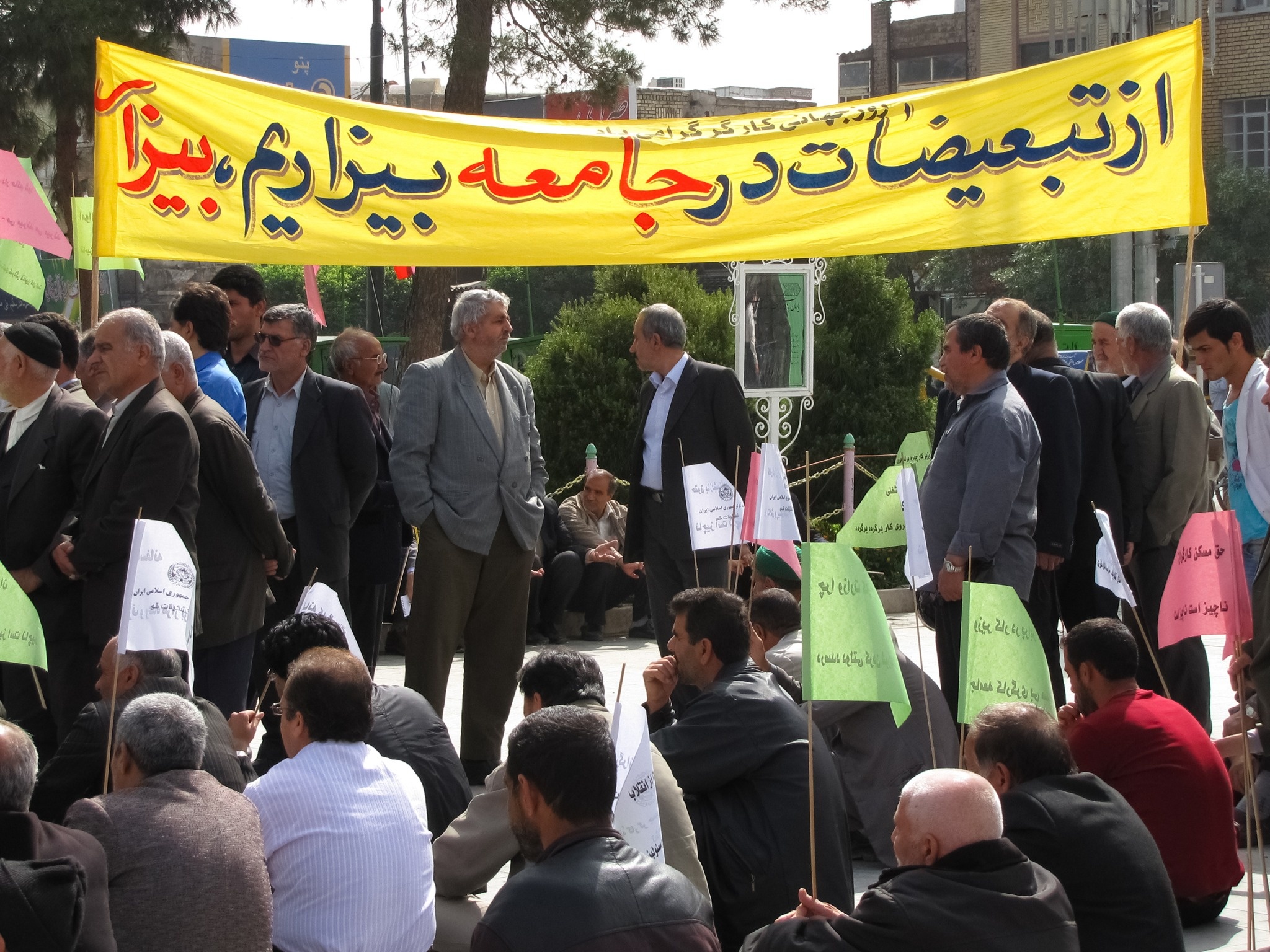
International Workers’ Day arrives amid stark state indifference. A wave of layoffs and the collapse of small businesses has swept across the country, deepening an already severe economic crisis.
Iran’s economic collapse long predates the recent US–Israel confrontation with the Islamic Republic. By late December 2025, worsening economic conditions had triggered strikes and nationwide protests, with demonstrators openly calling for regime change and an end to the Islamic Republic. The state responded with violent repression, including the massacre of thousands of citizens, among them over 200 children. Several Christians were also among those killed during the protests.
This crisis builds on more than four decades in which the authorities have weaponised the economy and institutionalised discrimination to restrict religious minorities’ access to employment and resources. Economic pressure—ranging from dismissal and blacklisting to the denial of business licences—has been systematically used to control and punish citizens and prisoners of conscience, including Christian converts.
Structural violence against minorities
From its earliest days, the Islamic Republic’s treatment of religious minorities – including those recognised in the Constitution: Christians (excluding converts), Zoroastrians, and Jews – has taken the form of entrenched structural violence. In this system of religious apartheid, laws formally relegate members of recognised religious minorities to the status of second‑class citizens.
Brothers at war, excluded in peace
Discrimination is codified in law. Under the Law of the Army of the Islamic Republic of Iran, approved by parliament on September 1987, adherence to Islam is a core condition for recruitment into the armed forces. This means that non‑Muslim citizens – including members of the recognised religious minorities – are barred from employment in the army, even if many risked and sacrificed their lives as conscripts during the Iran‑Iraq war (1980-88), solely because their ancestral religion is not Islam.
This practice also contradicts the Constitution. Article 28 of the Iranian Constitution explicitly states that “everyone has the right to choose any occupation he wishes, if it is not contrary to Islam and the public interests, and does not infringe the rights of others”, and that the state is obliged to provide opportunities for employment and create equal conditions for obtaining it. In practice, however, for the past 47 years we have lived in another reality, in which the policies of state institutions have emptied this article of meaning, as key branches of the state systematically refuse to employ citizens belonging to religious minorities.
Clerics as ‘the law’
The authorities have also used religious jurisprudence to justify discrimination. In the case of suspending Sepanta Niknam, a Zoroastrian member of Yazd’s city council, officials invoked the “no domination” (nafye‑sabíl) principle. Based on a reading of verse 141 of Surah al‑Nisa, this doctrine is interpreted to forbid any form of “infidels’ [non-believers] authority over Muslims.” Under this interpretation, even recognised religious minorities are deemed unfit to represent a Muslim electorate, thereby giving “religious” cover to their exclusion from political and civic participation – despite the existence of alternative interpretations that do not require such exclusion. In practice, this legal‑jurisprudential framework creates a “legitimising” environment for discrimination in the job market and the economic marginalisation of religious minorities.
Even a pro‑regime MP complained
The employment situation of minorities has become so dire that even Yonathan Betkolia, the Assyrian former representative to the parliament who was an otherwise loyal supporter of state propaganda, acknowledged – while still an MP – that executive officials refused to hire Assyrians and that arbitrary treatment by some authorities was driving Assyrians, already under severe economic pressure, to emigrate.
From exclusion from work to exclusion from life
The state has weaponised the economy for decades as a tool of pressure and punishment, routinely depriving individuals of work and livelihood as a means of repression against unrecognised religious minorities such as Christian converts and Baha’is. In countless cases, judges and security agencies have deemed prison, exile, and fines insufficient and have imposed employment bans that effectively strip individuals of the right to earn a normal livelihood and even survive. The aim is not merely temporary punishment, but economic warfare intended to force believers to renounce their faith, emigrate, or be gradually erased from public life.
Direct court verdicts
In some cases, these sanctions are set out explicitly in court verdicts. In the case of one family, brothers Sam and Sasan Khosravi and Sam’s wife Maryam Falahi, the court not only imposed prison sentences and internal exile, but also banned the brothers for two years from working in their specialist profession in the hospitality sector. Maryam’s additional lifetime ban on employment at any national institution, including the hospital where she had worked as a nurse for many years, was a particularly severe blow. Later, the persecution of Sam and Maryam made national and international headlines, when a court ordered that their adopted daughter be removed from their care solely because of their Christian faith.
‘Deprivation of social rights’ as punishment
One of the penalties increasingly imposed on Christians prosecuted for their peaceful religious beliefs and activities is “deprivation of social rights”. This includes bans on employment in state institutions and on serving as board members or managers of state‑affiliated companies. For example, in May 2025, judicial authorities sentenced three Christian converts – Abbas Souri, Mehran Shamloui, and Narges Nasri, who was pregnant at the time – not only to prison terms and fines, but also to 15 years of social deprivation each. These cases are only a few examples of the “economic war” waged by the authorities against Christian converts over the past 47 years.
State pressure beyond court verdicts
Elsewhere, pressure continues after release from prison through direct interference in employment. Christian convert and former prisoner of conscience Ali Kazemian, for example, was dismissed from Maskan Bank after 10 years of service following orders from security bodies. He later explained that “wherever I found work, within a few days the employer would say they had been threatened and told not to hire me”. The result for people like Ali is an inability to meet even basic living expenses and the denial of minimal economic security.
In the shadow of intelligence agents
Another convert and former prisoner, Alireza Aghajeri, lost his business licence and later faced obstacles even in trying to obtain simple jobs such as driving a taxi. As he noted, while many social offences are overlooked, “for so‑called ‘belief‑related crimes’, they do not allow you to work at all”. These accounts reveal a clear mechanism of economic erasure: the imposition of a “security” label that translates directly into exclusion from the labour market and, in turn, from social life.
From supporting workers to valuing work
Although Christians themselves are victims of economic discrimination, they have repeatedly stood in solidarity with workers and other “voiceless” groups in society. Christian convert Ebrahim Firouzi, who spent more than seven years in prison and internal exile because of his faith, wrote from Rajai Shahr Prison in 2018 to denounce the government’s policies and express support for the truck drivers’ strikes, calling for the release of detained drivers.
Serving others as a calling
This solidarity with workers reflects a deeper tradition among Iranian Christians, one that ties work to human dignity. Samuel Jordan, the Presbyterian missionary and founder of Alborz High School in Tehran, considered the “value of work” a cornerstone of education. Students carried out physical tasks and learned that manual labour is neither degrading nor shameful, but rather valuable and integral to the formation of character; in some cases, these activities helped students pay part of their tuition.
The same spirit is evident in the recollections of Yahya Armajani, a convert and one of Jordan’s former students who was later a Presbyterian pastor and history professor at Macalester College in the United States. He wrote that one of the key mottos at Alborz was that “our goal is to love and to serve our fellow human beings” – a principle Jordan and his students put into practice through acts such as tree‑planting and literacy work in rural areas.
Work as a human right
Article 23 of the Universal Declaration of Human Rights affirms that everyone has the right to work, to free choice of employment, and to just and favourable remuneration. In today’s Iran, that right is systematically violated, especially in the case of political dissidents, prisoners of conscience, and religious minorities – particularly Christian converts and Baha’is – who face a combination of discriminatory policies, economic pressure, and security‑driven restrictions. In their case, livelihood itself has been turned into a lever to coerce belief and punish dissent.


0 Comments