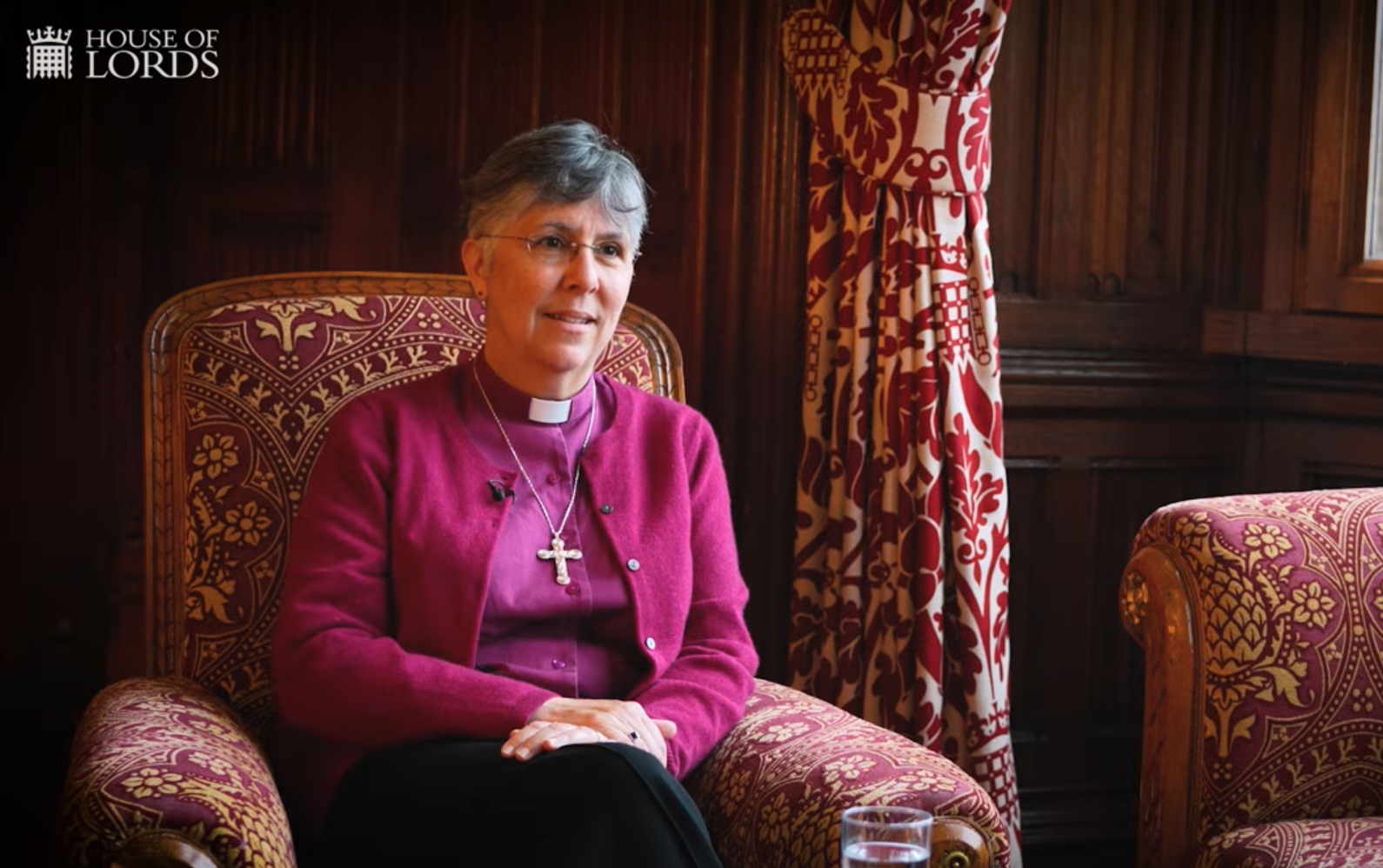
Iranian-born Church of England bishop Guli Francis-Dehqani was interviewed recently for a new podcast by the Speaker of the House of Lords.
In the episode, which can be viewed in full here, the bishop spoke, among other things, about her upbringing in Iran; her father’s role as the first Persian Bishop of Iran; the persecution that followed the 1979 revolution, including the murder of her brother, Bahram; and her views on recent events in Iran.
You can read a few snippets of the conversation below:
‘We were viewed as those who had betrayed our national identity’
“We were regarded as those who’d betrayed our national identity, to an extent, by buying into this ‘foreign religion’, as it were.”
‘My father voted for the Islamic Republic’
“The [previous] regime had become corrupt and absolutely needed changing, but my father was very much in favour and voted for the Islamic Republic. But I always remember him telling me that … on his voting slip he had ticked yes, but he wrote on it: ‘As long as you keep to your promises of freedom and respect for people in the country’. So it was on that basis that he was supportive. And of course, that didn’t prove to be the case and very quickly our lives began to change [for the worse].”
Increased vulnerability
“I do remember the feeling of being very vulnerable and exposed. One week the missionaries were still all there and then … I can’t remember exactly when it was, but all foreigners were pulled out of the country. So the following week they just weren’t [there] and we were left, a very, very exposed, vulnerable, small community, very uncertain about what the future held.”
The murder of Rev Arastoo Sayyah
“I suppose the first indication for us as a church community was that one of the clergy, in the [city] of Shiraz, further south in the country, was found murdered in his study by two men that he had known, who had been visiting him as so-called ‘people who were interested in finding out more about Christianity’.
An attempt on the bishop’s life
“Over the course of the ensuing year or so, [Christian] institutions were either closed down or taken over, offices were ransacked. The bishop’s house, where we lived, was ransacked. My father was briefly imprisoned for a while and then eventually there was an attempt on his life in the early hours of the morning in late October 1979, two gunmen broke into the house, clambered over the walls, found their way to my parents’ bedroom. They were asleep in bed and they called him by his name and then fired five bullets and extraordinarily – they were probably closer than I am to you now – they missed. My mother was shot. My mother threw herself over him in an effort… She used to say it was, she thought they’d come to take him away again to prison and it was just instinctive to protect him. So she was injured, but he survived and they left the country.”
The pillowcase
“I don’t know exactly why my mother brought it, because when we left Iran, we left really quite suddenly and without many belongings, but she did bring this pillowcase with her and I’ve inherited it now. I think it is an extraordinary thing to look at because you can see what looks like a halo of bullet holes. You can see where his head would have been and the bullet holes go round. And they often used to say that if my mother hadn’t been injured and if there wasn’t this pillowcase of proof, people just wouldn’t have believed them. So I don’t know whether it was for her something concrete that this had really happened. And some people may think it’s a bit macabre, but yeah, I keep it. It’s actually framed … It’s not hung up on a wall, but I have it up against the wall in my office and I use it from time to time in talks that I give and it often fascinates people. So yes, I still have that.”
Bahram’s murder
“Then my brother was murdered. My brother was 24 and no-one was ever brought to justice. His car was ambushed and he was killed. We’ve always understood by piecing various bits together that he was a scapegoat for our father, that really they had no interest in him. Possibly they thought my father would come back for the funeral, possibly it was an act of revenge, who knows what? But at that point, the rest of us left to be with my father, after we’d buried my brother, assuming we’d be back home within a few months, but of course the situation never changed and eventually we settled and began to make a life here.”
The current situation in Iran
“I’m deeply troubled by what’s going on in Iran … When the most recent war started and the bombs started to drop, I recognised what some of my countryfolk were saying, which was, ‘This is it. This is going to change the regime and it will bring us freedom.’ I recognised the kind of hope for that in the pit of my stomach, but I also had quite a strong sense that this is not how things are going to change in Iran. In the end, the solution has to come from within Iran. I don’t know how and I don’t know when because the hold of this regime is no longer a moral hold. It is purely a brutal, physical, very, very violent hold. And so now we are seeing them double down on those brave, courageous people who came out onto the streets back in December and January, and again when President Trump encouraged them to do so with the most recent war: ‘Come out, help is coming, come out onto the streets.’ Those very people now are in prison cells and I heard just yesterday on Radio 4 an account, a horrific account, of some of the young people who’ve just recently been executed. Every day there are executions taking place of people in their 20s, 30s, young people who should be the hope of the country. I don’t know where this ends.”
‘This regime is in its death throes’
“I absolutely believe that this regime is in its death throes, but death throes can last for quite a long time and people can thrash around, and the violence might well yet increase, but of course they’re partly as brutal as they are because they are fighting to survive, and what we need is an effective resistance movement around which people can coalesce, which will eventually bring freedom.”
‘I continue to hope and pray for the future’
“I continue to hope and pray every day, both for the tiny Church there, the Christian community, the Anglican community and others, but also for the future of the country, which at the minute, what was one of the greatest civilisations of the world is now a cause of great shame and embarrassment to many Iranians. And the people, the ordinary people, are caught between the uncertainty and fear of when the next bomb is going to drop and a very brutal regime. It’s a horrific scenario and it’s heartbreaking.”
0 Comments