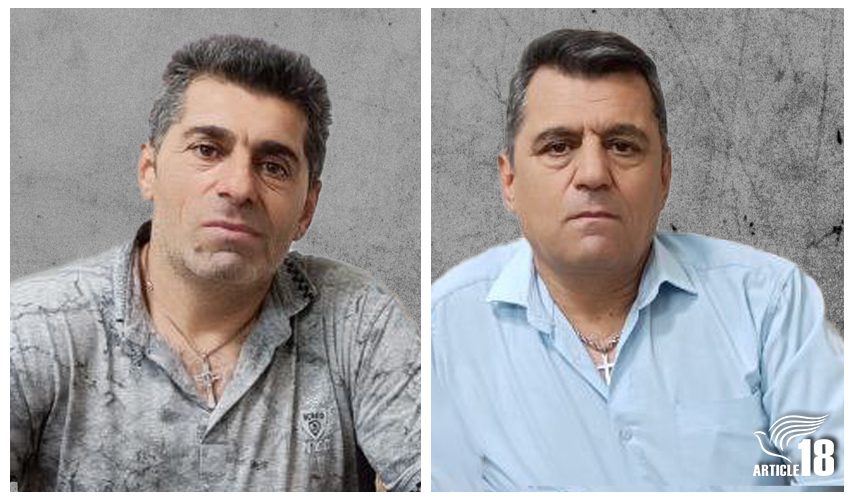
Two brothers arrested at a Christmas gathering four years ago were this Christmas summoned to begin four-year prison sentences on charges related to their Christian beliefs and activities.
Mahmoud and Mansour Mardani-Kharaji, Christian converts who are both in their 50s, began serving their sentences on 16 and 20 December respectively in Isfahan’s Dastgerd Prison.
They also face two years’ exile from their home province of Isfahan following their release, and are banned from membership of any groups for five years. Additionally, they were fined the equivalent of around $1,500 each.
The brothers were convicted under the amended Article 500 of the penal code, under which many Christians have been convicted in recent years and which criminalises “deviant propaganda activities contrary to the holy religion of Islam”.
Two other Christians who were arrested alongside the brothers and who cannot be named were also present at the court hearings in November 2024 and January 2025, but the charges against them were dropped.
Another Christian convert, Nayereh Arjaneh, began serving a 10-year prison sentence over the Christmas period in Semnan, east of Tehran, while another, Aida Najaflou, was temporarily released from Tehran’s Evin Prison amid concerns that she may be at risk of paralysis after fracturing her spine when falling out of her prison bunk bed.
Aida was one of five Christians sentenced to a combined more than 50 years in prison late last year on charges related to ordinary Christian activities, including celebrating Christmas.
The exiled son of the former Shah of Iran, Crown Prince Reza Pahlavi, highlighted their sentencing in a letter to the Pope on Christmas Eve.
As I extend my best wishes to all those celebrating Christmas, I am writing to Pope Leo XIV (@Pontifex) asking him to be a voice for the Christians of my country, Iran. Your Holiness, in this season of peace, my people are suffering persecution. I ask you to hear their voice.… pic.twitter.com/eO21ggNGfj — Reza Pahlavi (@PahlaviReza) December 24, 2025
Mr Pahlavi said that Christian converts, including to Catholicism, experience “quiet but relentless persecution” in modern-day Iran.
“The Islamic Republic’s ‘security’ services and Revolutionary Courts increasingly treat peaceful belief and worship as criminal acts, punishing with lashes, lengthy prison sentences, internal exile, and even execution those who pursue the Faith,” he wrote.
“The regime imprisons those who receive the Holy Communion for ‘drinking alcohol’, raids house-churches, and is cracking down on ordinary religious expression online with accusations of vague ‘threats to national security’.”
The Crown Prince cited figures from Article18’s 2025 annual report, as he noted that Christians in Iran experienced a sixfold increase in prison sentences in 2024 compared to 2023 “for ‘crimes’ directly related to the practice of their faith”.
He also referenced the case of pregnant Narges Nasri and two other Christian converts – Abbas Souri and Mehran Shamloui – who were sentenced to a combined more than 40 years in prison in 2025, forcing them to flee the country. (Mehran was later deported back to Iran and is now serving an eight-year sentence.)
“The Islamic Republic outlaws conversion to the Christian, or any other faith, and punishes those who seek to worship God in a new way by charging them with ‘warring against God’,” Mr Pahlavi wrote.
He noted that this “crime” even carries the death sentence, and cited the killing of Iranian Christian leaders in years past, including Rev Mehdi Dibaj, Bishop Haik Hovespian, Rev Tateos Michaelian, and Rev Hossein Soodmand, who was hanged for his “apostasy”.
Mr Pahlavi called on the Holy See to “help in bringing the plight of Iran’s persecuted Christians into clearer international view” by “raising the plight of Christians in Iran with international authorities through diplomatic channels, urging the release of imprisoned converts”.
“Speaking publicly to and on behalf of Iran’s converts, especially during this sacred season, would go a long way in letting those Iranians suffering in silence know they are present in the prayers of the Church,” he said.
0 Comments