This paper, written by Iranian-Armenian journalist Fred Petrossian, was presented today at the 2026 conference of the Institute for the Study of Freedom of Religion or Belief (FoRB) in Leuven, Belgium.
Abstract
This paper examines the condition of religious minorities in Iran through the lens of systemic discrimination and international influence. Using Johan Galtung’s framework of direct, structural, and cultural violence, it argues that religious minorities experience an institutionalised form of inequality that can reasonably be described as religious apartheid.
It further evaluates the role of European and international actors, highlighting both concrete effects—such as legal restraint produced by sustained international pressure—and clear limitations, including narrative capture, selective advocacy, and political inconsistency. The paper argues that outside engagement can mitigate some of the Islamic Republic’s most extreme practices, but has not transformed the underlying structures that subordinate minorities within an exclusionary religious state.
1. Introduction
Religious minorities in Iran face a dense system of marginalisation embedded in legal discrimination, political exclusion, social control, and ideological hierarchy. While some communities are formally recognised by the Constitution, their rights remain sharply restricted in practice, and unrecognised groups are exposed to even more severe repression. This gap between nominal recognition and lived inequality is one of the defining features of the Islamic Republic’s treatment of both non-Muslim citizens and Muslim communities that fall outside the state’s accepted religious boundaries.
The problem is not simply episodic intolerance. Rather, the state defines rights through an Islamic framework in which citizens are not treated as equal members of a political community, but are ranked according to their conformity with the ruling religious order. Non-Muslims and disfavoured Muslim minorities are therefore denied equal access to public authority, employment, legal protection, and cultural autonomy. The result is a layered system of exclusion that shapes everyday life as well as long-term access to security, participation, and dignity.
This paper asks: to what extent can European and international intervention influence the condition of religious minorities in Iran? It argues that such intervention can matter, especially when it is sustained, coordinated, and tied to diplomatic or legal costs. However, its impact remains limited so long as it does not confront the deeper ideological, legal, and narrative structures that sustain religious inequality in the Islamic Republic.
2. Triple violence and religious apartheid
Johan Galtung’s framework of direct, structural, and cultural violence offers a useful way of understanding how repression against religious minorities in Iran operates at several interconnected levels. Direct violence refers to visible acts of harm such as execution, imprisonment, kidnapping, physical intimidation, and the destruction of churches, cemeteries, and monasteries. Structural violence appears in the laws, institutions, and administrative practices that restrict employment, inheritance, testimony, education, and representation. Cultural violence consists of the narratives and beliefs that normalise this inequality, including doctrines portraying minorities as inferior, dangerous, ritually impure, or unfit to exercise authority over Muslims.
Taken together, these forms of violence support the characterisation of Iran’s system as one of religious apartheid. Minority communities are not merely disadvantaged; they are placed in a legally and ideologically inferior position that shapes access to power, livelihood, justice, and belonging. The distinction between recognised and unrecognised minorities changes the degree of repression, but not the underlying hierarchy.
3. Recognised minorities and graded citizenship
Article 13 of the Constitution recognises Zoroastrian, Jewish, and Christian Iranians as the only religious minorities allowed limited freedom in matters of worship, personal affairs, and religious education. In practice, however, recognition functions less as equality than as conditional tolerance under close state supervision. Churches are forbidden from openly receiving converts, minority ceremonies may be monitored, and community life remains vulnerable to intervention by intelligence and cultural bodies.
The doctrine that forbids non-Muslim “dominance” over Muslims illustrates the logic of graded citizenship. It was visible in the suspension of Zoroastrian councillor Sepanta Niknam and helps explain why non-Muslim citizens may be praised as patriots in wartime yet barred from meaningful roles in the army or many public institutions. Constitutional language on equal opportunity is thus limited by a deeper confessional hierarchy that conditions full participation on religious status.
4. Structural discrimination in law
The Islamic Republic’s legal order codifies unequal worth in several key areas. Inheritance law allows a Muslim heir to displace non-Muslim relatives, while rules concerning testimony and other areas of personal-status law continue to reflect confessional hierarchy. Historical distinctions in blood money and retaliatory punishment further reveal a legal tradition in which Muslim and non-Muslim lives have not been treated as fully equal.
These legal structures do not simply deny formal equality; they also produce material consequences. By restricting access to jobs, state institutions, and legal protection, the system imposes poverty, insecurity and exclusion while marginalising minorities from the spaces where decisions are made. Legal discrimination is therefore inseparable from broader forms of structural violence.
5. Apostasy and the impact of international pressure
One of the clearest examples of international influence concerns apostasy and stoning in the revision of Iran’s Penal Code. According to the source text, a retired judge involved in the process later acknowledged that apostasy was left out of the final text out of fear of international condemnation, and that the punishment of stoning was similarly restricted. This is significant because it suggests that sustained criticism from international bodies, civil society, and foreign governments can shape what the state is willing to codify openly.
The case of Marziyeh Amirizadeh reinforces this point at the individual level. Sentenced to death and imprisoned in Evin, she later stated that the intervention of Pope Benedict XVI helped save her and another woman from death and prolonged imprisonment. Such cases show that international advocacy can reduce immediate harm, even if it does not dismantle the broader structures of repression.
Resistance and creativity
Iran’s religious minorities should not be seen only as victims. Despite imprisonment, social exclusion, and the loss of status, they have shown remarkable resilience in preserving their faith, identity, and collective dignity. Their responses offer an important example of creative and non-violent resistance for communities far beyond Iran.
The Baha’is, for example, have developed forms of “constructive resilience”, most notably through the Baha’i Institute for Higher Education, an informal university created after Baha’i students were barred from higher education. Christian converts have likewise built forms of resistance through house-churches and campaigns such as the demand that all Christians should have a place to worship, insisting on the right to communal religious life despite closure, surveillance, and repression. Yarsanis, meanwhile, have used demonstrations, public assertion of rights, and music as a means of affirming and defending their identity in the face of exclusion and erasure.
6. Narrative struggle: Shannon-Weaver and the regime’s counter-system
A simplified application of the Shannon–Weaver model helps clarify how information about violations of FoRB travels from Iran to European and international audiences. In this framework, political prisoners and their families function as primary senders, producing first-hand testimony about arrest, abuse, discrimination, and exclusion. Reporters, activists, and NGOs act as transmitters, collecting and relaying these accounts through channels such as interpersonal communication, digital platforms, and international media. At the level of decoding and validation, NGOs and expert bodies assess credibility, contextualise claims, and forward verified information to principal receivers, including the EU, UN, human rights organisations, and broader public audiences.
The Islamic Republic does not merely introduce “noise” into this process. It actively interferes at multiple points: pressuring families, intimidating witnesses, filtering communications, and surveilling digital exchanges in order to suppress messages before they circulate. However, the regime’s intervention goes beyond disruption. It constructs a parallel communication system designed to substitute the original message with an official narrative.
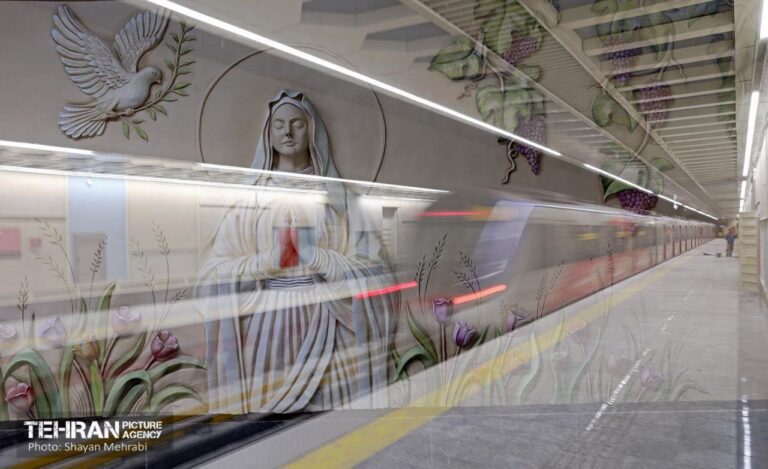
This alternative system operates through political delegations, aligned academics, sympathetic commentators, and officially sanctioned minority representatives whose public statements reflect state discourse. Cultural representation also plays a role: curated images of historic churches or minority heritage are circulated internationally, while confiscated properties and ongoing repression remain invisible. In this way, the regime does not simply contest information but seeks to redefine the interpretive framework through which it is understood.
When senior officials claim in think-tanks or media interviews that no-one is imprisoned for their beliefs, this should not be read as mere defensive rhetoric. Rather, it constitutes an attempt to displace documented evidence with an authorised narrative—transforming repression into a form of acceptable public discourse.
A similar logic applies to regime-approved intermediaries. Religious minority MPs, whose candidacies are vetted through the Guardian Council, or foreign scholars and guests with privileged access, can act as alternative “senders” within this parallel system. Their messages—disseminated through social media, academic platforms, or Western media outlets—often encounter little restriction and are amplified by audiences seeking evidence of “tolerance” in Iran. Recent cases, such as leaked documents linking an Iranian-Swedish academic to Tehran’s influence networks, illustrate how this counter-system extends beyond Iran’s borders into international knowledge production.
The issue is not only the actions of the Islamic Republic, but also the indifference and complacency of certain Western institutions. Whether intentional or not, these actors have at times enabled the circulation of regime-aligned narratives in media and academia. This dynamic reflects a troubling mix of political interests, passivity and, in some cases, ideological sympathy.
7. Europe between principle and policy
The EU’s role is shaped not only by its formal commitment to human rights—including FoRB, as articulated in Article 10—but also by longstanding political interests and the framing of public opinion. The influence of civil-society actors and the quality of the narratives that European institutions accept, fund, or amplify play a significant role in shaping its engagement.
European action has at times produced positive effects, including raising concern over the death penalty for apostasy, supporting conferences on religious freedom, and promoting FoRB as a core normative principle. However, these efforts have often remained inconsistent, fragmented, and vulnerable to geopolitical bargaining.
7.1 What the EU should avoid
The first danger is direct or indirect support for institutions that function as extensions of the regime’s ideological or political influence in Europe. The long period during which projects connected to entities such as the Islamic Centre of Hamburg could receive public legitimacy or benefit from European openness demonstrates the risk of allowing regime-linked structures to embed themselves within democratic space. Such engagement does not amount to harmless pluralism when these centres reproduce authoritarian narratives and networks.
In 2019, after a series of exposés in Germany’s top-selling paper Bild, the newspaper reported that the interior ministry announced in a letter the stoppage of funds for a Shi’ite umbrella organisation controlled by Iran’s Supreme Leader. The only question is: why did it wait until then?
A more recent investigation reported by BruxellesToday also highlighted the presence of a network of Iranian-linked structures operating across the Belgian cities of Brussels, Antwerp, and Ghent. Although these organisations present themselves as formally distinct, they reportedly share overlapping actors and activities, enabling them to expand their presence while maintaining an appearance of independence. Their objectives appear to be multifaceted: organising events, promoting narratives aligned with the Iranian regime, and, in some cases, collecting funds. The investigation also points to alleged practices of monitoring political opponents and disseminating a political doctrine inspired by the authorities in Tehran. Among the entities mentioned is the Al-Mustafa Foundation, based in Antwerp, which is described as being connected to an Iranian university under US sanctions and reportedly involved in organising a demonstration in Brussels.
A second danger lies in allowing academics, consultants, or self-presented experts with regime-aligned framings to reshape public understanding of reality in media and policy circles. When such voices minimise compulsory hijab, dismiss the persecution of religious minorities, or recast religious apartheid as misunderstanding, they contribute to narrative capture rather than informed debate. A third issue is believing that what minority representatives from Iran’s Majlis (parliament) say is the reality on the ground, when in fact they simply repeat state discourse about coexistence and tradition while remaining silent about confiscated churches, legal discrimination, censorship, and the denial of equal rights. In this way, Europe risks platforming a curated image of “tolerance” while obscuring the very communities it claims to support.
7.2 What the EU can do right
A more coherent European approach would combine principled rhetoric with targeted policy tools. One practical step is the use of sanctions against officials, judges, security actors and institutions responsible for violations of the rights of religious minorities, in a manner broadly comparable to recommendations made by the United States Commission on International Religious Freedom (USCIRF) in the American context. Linking abuses to named costs would signal that violations of FoRB are not a peripheral issue. The recent placing of the Islamic Revolutionary Guard Corps (IRGC) on the terrorist list was also a very important step.
Protection for refugees and asylum-seekers is another area where Europe can make a meaningful difference. Supporting vulnerable members of religious minorities in transit countries such as Turkey, and strengthening pathways to protection in countries such as Sweden and other EU states, can help prevent further victimisation while preserving communities under pressure. Europe can also support well-designed conferences, documentation initiatives, and FoRB-focused forums that amplify the voices of affected minorities, independent researchers, and rights-based NGOs rather than reproducing generic interfaith symbolism.
8. Conclusion
The condition of religious minorities in Iran is produced by an interlocking system of direct, structural, and cultural violence. This system creates a graded order of citizenship in which legal inferiority, social exclusion, and ideological stigmatisation reinforce one another. The language of “religious apartheid” is therefore analytically useful because it captures how discrimination is embedded in law, institutions, and public discourse.
European and international intervention can matter. Evidence cited in this paper suggests external pressure has helped to prevent or limit some of the harshest legal measures, while targeted advocacy has protected individuals in moments of extreme danger. But such intervention remains constrained when it is inconsistent, filtered through geopolitical compromise, or weakened by narrative normalisation in international media and policy spaces. The central challenge is not only whether outside actors denounce repression, but whether they are willing to confront the structures and stories that sustain it.

0 Comments