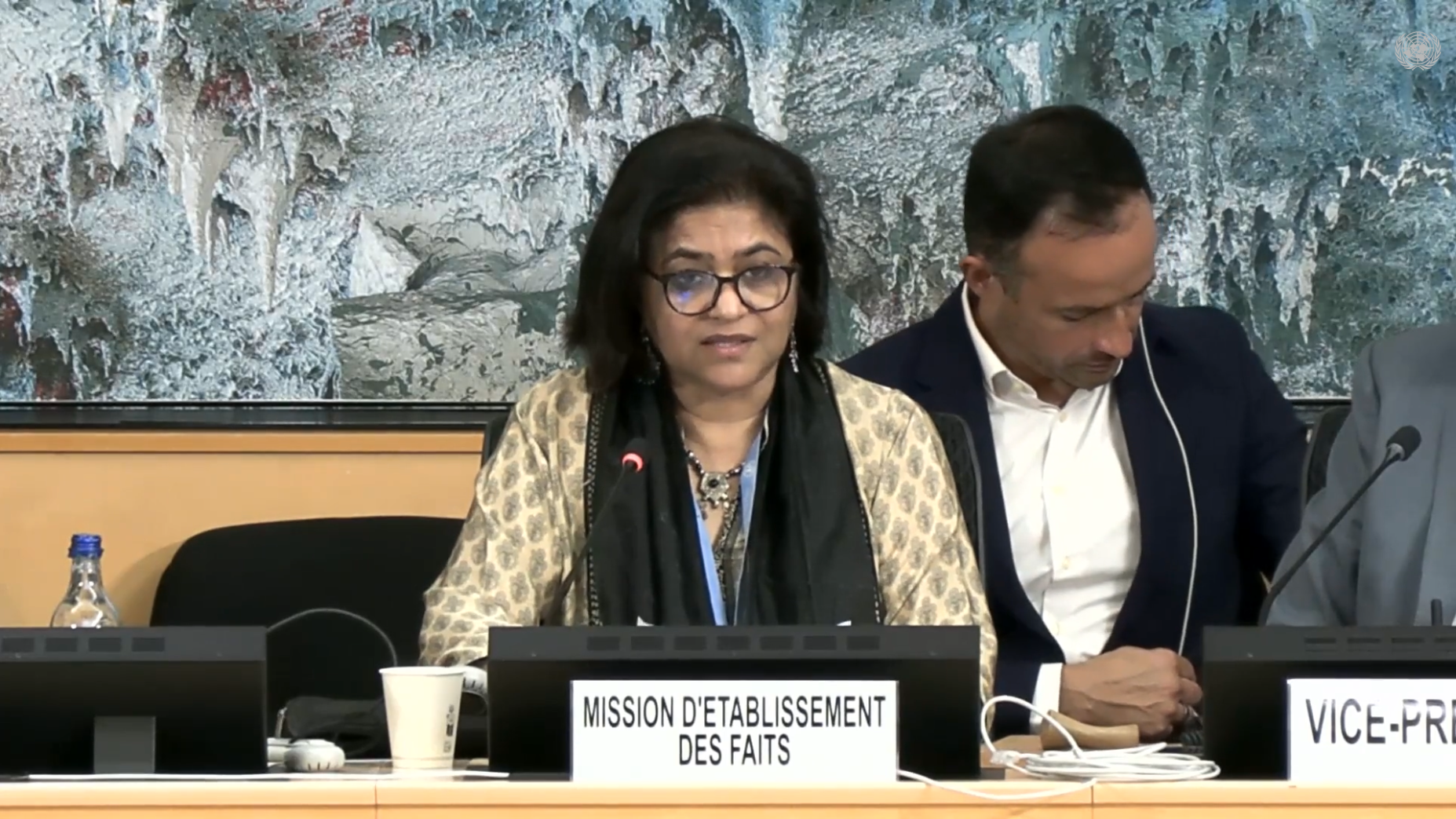
The chair of the Fact-Finding Mission on the Islamic Republic of Iran (FFMI) has called for “long-term, flexible and sustained support” for Iranian civil society organisations, “particularly women-led and minority organisations, because they’re the ones documenting violations and representing survivors”.
Sara Hossain was speaking as part of an interactive dialogue yesterday with members of the Human Rights Council in Geneva, during which she presented her team’s latest report.
Ms Hossain called on Iran to release “all arbitrarily detained”, “cease all human rights violations and crimes against humanity” and undertake “effective, independent and impartial investigations” into them.
“Iran must ensure accountability, provide reparations, and guarantees of non-recurrence, including structural reforms,” she said, adding:
“Considering the reservations many victims have expressed on the prospects of effective justice and accountability within Iran, we call on member states to pursue third state accountability for such violations and crimes through universal jurisdiction, while ensuring emergency support to victims.”
Several member states highlighted the repression of religious minorities during their addresses, with the representatives of Australia, Italy, Austria, Ireland, New Zealand and Spain all drawing particular attention to the persecution of Baha’is.
The situation of Christians, Christian converts and the recent demolition and confiscation of church buildings in Iran were not specifically mentioned, though member states including Albania, France, Slovenia, Germany and the representative of the EU highlighted the situation of minorities more generally.
Meanwhile, the most common question for Ms Hossain regarded, in her words, “accountability, impunity, and the protection of victims and their access to truth, justice, and protection”.
In her response, Ms Hossain called on member states to “prioritise accountability measures in dealing with individuals on their territory who may be responsible for violations and crimes in Iran”, and “make full use of the legal tools that are already available … [including] opening investigations into crimes under international law committed in Iran with a view to prosecuting alleged perpetrators”.
“This includes applying the principle of universal jurisdiction, as well as other bases of extraterritorial jurisdiction, for example, the nationality of the victim, where the latter is a national of the prosecuting state, or using existing legislation based on international humanitarian law and human rights treaties, such as the Convention Against Torture,” she said.
Ms Hossain also recommended “facilitating future prosecutions of alleged perpetrators by opening structural investigations into violations and crimes in Iran”, which she said could be “an important way of preserving evidence”.
Ms Hossain also suggested parties to the Convention on the Elimination of All Forms of Racial Discrimination “could and should enter into negotiations with Iran with regard to its compliance with obligations under that convention”.
“Accountability is really only possible where victims can safely exercise their rights and where civil society remains strong and active,” she concluded. “We therefore recommend that states act to protect victims and survivors, providing protection, humanitarian pathways, opening their borders where necessary for those who are fleeing persecution, and also providing protection inside their borders, particularly for cases of transnational repression, through investigation and action against those responsible, and protection of victims and their families.”
You can watch the dialogue in full here.


0 Comments