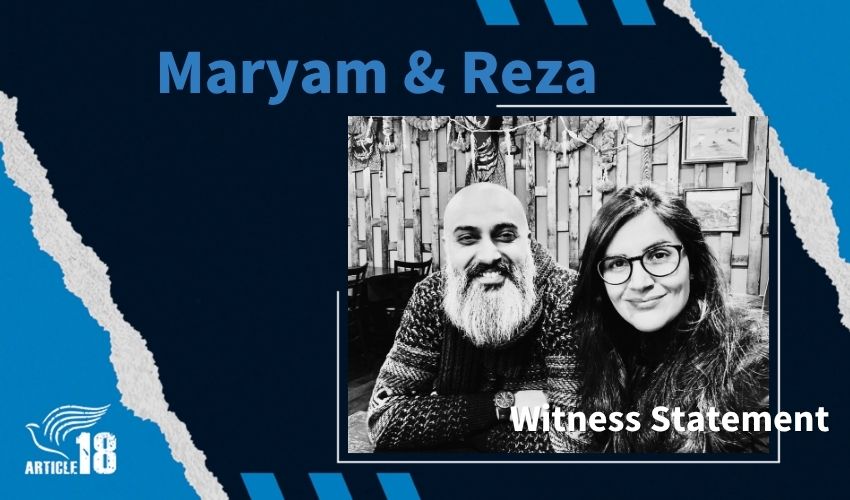
For a summary of Maryam and Reza’s story, you can read our feature article here.
Conversion
Maryam
1. My name is Maryam Bateniya and I was born in Isfahan in 1981. My family moved from Isfahan to Shahinshahr [just north of Isfahan] and I grew up and continued my studies there until I obtained a postgraduate diploma in computer science. Since I was the last child in the family, I lived in my father’s house and took care of him, as he was old and my mother had died when I was young. I also worked in my brother’s clothing store for a while.
2. In 2003, my younger brother was the first person in our family to become a Christian. About three months later, he talked to me about Christianity and gave me a Bible. I studied it and, a year later, in 2004, I also converted to Christianity. Three months after me, most of my family also became Christians.
3. At that time, an official church building was open in Shahinshahr and we initially went there. But the pastor was due to be transferred to another church in Isfahan, and a new pastor was supposed to come to the Shahinshahr church, and that period coincided with the arrest of a large number of pastors at a gathering at Sharon Garden near Karaj. For this reason, most Christians were afraid to go to the church building and we decided to join a house-church.
4. Our house-church had different groups, including a young-adults group, which I joined, and which gathered at my brother’s home. Each person only associated with members of their own age group, and didn’t interact with the members of the other groups.
Reza
5. My name is Reza Mousavi and I was born in 1980 in Abadan [in southwest Iran] but grew up in Shahinshahr. Overall, I had a happy and good childhood and adolescence, and I was able to obtain a master’s degree in architecture. My family believed in Islam, and we accompanied my father to the mosque. He taught me how to practise the Islamic faith, and I also helped lead the prayers for a while.
6. But when I was around 22 or 23 years old, I had a sense of emptiness and felt I needed something more. My parents, although they practiced Islamic rituals, were very open-minded and respected the beliefs of others, and this allowed me to be free in choosing my own beliefs. I was always interested in poetry and mysticism. For this reason, I listened to talks by mystic scholars such as Hossein Elahi Qomshehi for a while, and I also researched some other religions, but I didn’t find what I was looking for.
7. Then one day, while changing satellite television channels, I read at the bottom of the screen the name “Rev Afshin”, and this was new and strange to me because Afshin is a Persian name, and I thought to myself: “How can a Persian-speaking person be a reverend?” This attracted my attention and led me to watch that Christian programme. I also started to watch two other Christian programmes and to listen to a number of Persian-speaking pastors on satellite TV.
8. One day, one of these pastors shared a message about repentance from sin and I felt that I was looking for exactly what the pastor was explaining, and that this was what I wanted. So, in July 2004, I became a Christian.
9. The day after I became a Christian, a flood of thoughts came over me. I spoke to God and said: “Oh God, I don’t know who you are. I am in a deep dilemma right now between my inherited religion and what I heard about Christianity. I ask you to accept me as a Christian for now, but I promise to do my research and then to make a serious and firm decision. I ask you to show me yourself. I am not looking for this religion or that religion; it is only important for me to be with you.” I had read the Quran before, but I studied it carefully again and at the same time watched the programmes of Christian channels. With further research and also a dream in which I met Christ, I concluded that the path I had chosen was the correct one.
10. When I became a Christian, I was working as a draftsman and assistant engineer in an office in Shahinshahr. After a while in the construction industry, I took on the work of implementation and worked on various projects, as a workshop technician and implementation manager.
Maryam
11. Reza and I were friends for a year before we became Christians. It was about three to four months after I became a Christian that I talked to him about my conversion, and he also told me about his conversion.
Reza
12. At first we were unaware of each other’s conversions, but I noticed that Maryam’s behaviour had changed, and this had interested me. One day she told me: “Honestly, these changes you see in me are related to someone I met and it is in your best interest that you get to know him too,” and she talked to me about her conversion to Christianity and the Christian belief. Maryam thought I was listening to her, but my ears weren’t hearing her, because I was stunned and amazed by Maryam’s conversion to Christianity. Halfway through what she was saying, I interrupted her and told her that I also watched Christian programmes and had also become a Christian. But I told her that I didn’t have a Bible and didn’t know what to do. Maryam then gave me a Bible as a gift, and I read it with great enthusiasm within one month.
House-church
13. After a while, I started talking to my relatives and friends about Christianity. In this way, our number increased and we formed a house-church. We spent time praying and fellowshipping together and strengthening each other, and downloaded and read many Christian resources from the Internet.
14. Then, through the friend of a friend, we heard about a house-church called “Martaeh Sabz” [Green Meadow] and joined it and were taught and grew up under the supervision of leaders like Atena and Leila Fooladi.
Maryam
15. There were about 10 or 11 members in our house-church, which my family and I attended from 2004 to 2006, but the pastor of the official church was responsible for two congregations so was less able to take care of our house-church, so after a while my family and I left that house-church and weren’t connected to any church for about two years.
16. Finally, at Reza’s suggestion, we joined his “Martaeh Sabz” house-church, and every week the leaders held church meetings for my family in Shahinshahr.
17. At my first house-church, our activities had focused on supporting the other members of our group, but in “Martaeh Sabz” we did activities we hoped would be useful to the community outside the church. For example, once a week, we would go to the Isfahan nursing home, which was very dirty, and from morning until evening would clean the rooms of the elderly, read parts of the Bible with them, and pray for them.
18. Two members of our group also decided to open a private orphanage in Shahinshahr, though their resources and facilities were very limited. At first, the Welfare Organization, which didn’t easily trust volunteers, entrusted them with three abused children, who were in a very bad way. We spent time with them, talking and playing, but in order to ensure we didn’t encounter problems with the Welfare Organization, our church decided that our other members shouldn’t go there, and that only the two members who had set up the ministry would serve there. In 2008, Reza and I were invited to begin helping with different church activities, and I initially helped with our women’s ministry, and after a while, I served the children.
19. Reza and I got married in 2009, and in 2010, our son Daniel was born.
Reza
20. After I married Maryam, I decided to continue my education. I was accepted to university at the same time my wife became pregnant, and I continued my studies in architecture. Along with my studies, I worked on different projects in different cities. The professors and project supervisors helped me so that I could study and work at the same time.
21. Maryam and I were also invited to take on the responsibility of leading some house-churches. Because I was studying and working, my time was limited; however, Maryam and I led a Christian group in Yazdanshahr, which is on the outskirts of Isfahan.
Arrest
Maryam
22. Our house-church leader and his wife, who were Iranian-Armenians, lived in Tehran but came to Isfahan to hold special training classes for the active members of our house-church. On Wednesday, 20 February 2013, one such meeting was held at the home of our friend Ramin and his wife Nasrin Kiamarzi in Shahinshahr. The church leader was present that day, but not his wife, and he had asked all those responsible for leading house-churches to bring our reports of our activities to that meeting, and to hand them over to him on flash drives.
23. There were about 10 adults at that meeting, and a few children: Daniel, my two-year-old son; Leila and Peyman’s one-year-old daughter, Armita; and Bita and Amir’s eight-year-old daughter, Sarina. Reza had to visit the Yazdanshahr group that evening, so couldn’t attend our meeting.
Reza
24. Maryam and I were both responsible for the group in Yazdanshahr, and some of the members of this group were in a delicate condition, having been freed from drug addiction, so I tried never to cancel the meetings. I was responsible for the pastoral care of the men, and Maryam cared for the women. But that day, because of the meeting that had been scheduled and also because Daniel was unwell, I went to Yazdanshahr alone.
Maryam
25. Ramin and Nasrin’s apartment was in a building in Shahinshahr, and Ramin’s father, mother, and unmarried siblings lived on the first floor. Between 7.30pm and 8pm, about eight or nine male agents and one female agent, all in plainclothes, entered via the downstairs entrance and knocked on Ramin and Nasrin’s door. We were all shocked as they entered the apartment, and it was a scary moment.
26. The agents said that no-one should move. When they entered, we weren’t wearing hijab and one of the agents was filming us from the moment they entered. He filmed each of us and said: “Tell the camera your name, surname, and your city of residence.” After filming us, they told us to go and put on our hijab.
27. They searched all our belongings and the entire apartment, and insulted us. The worry and fear we all felt was evident on our faces, and one of the fears we all shared was that the rest of our group would be arrested. The agents separated us from each other and said that we weren’t allowed to look at each other, and at that moment I thought about our families and what would happen to them.
28. Everyone was sitting still, except for my son, who was wandering around. Meanwhile, the agents were searching the entire apartment – even the spice jars in the kitchen. Among the items they confiscated were our passports, ID cards, mobile phones, a computer hard drive, printer, books and cross statues.
29. My son hadn’t been feeling well that morning and I had taken his health insurance details with me so that if he got worse, I could take him to the clinic. We were covered by my father-in-law, who is a retired army officer. One of the agents searched my bag, saw the insurance papers, and said: “Is your husband in the army?” I said: “No, but my father-in-law is a retired officer.” He asked me some other questions, then gave me a mobile phone and told me to call my husband.
30. When we went to meetings, we would turn off our phones and remove our SIM cards, so I knew my husband’s phone would be off. As a result, I called him without concern, then told the agent his phone was off. The agent asked: “Why is his phone off?” I said: “Because my husband is working on a project. Projects don’t have specific hours, and usually when he’s at work, he either doesn’t answer or his phone is off and won’t connect.”
31. Later, we learned that the intelligence agents had installed a listening device in the home of Amir and Bita some time before our arrest, and knew that the homes of Nasrin and Ramin, Bita and Amir were our meeting places in Shahinshahr. Most of our books and church equipment were in their homes, as well as Leila and Peyman’s, and one agent took Bita and her daughter, Sarina, to their home to search it, while two other agents took Arina to search her home, then took her to prison.
32. Leila’s daughter Armita had a fever and wasn’t feeling well, but the agents wouldn’t allow Leila and Peyman to take her to the clinic. The female agent seemed kind, and I said to her: “Madam, I suppose you may have a child yourself. I can’t talk to these gentlemen about motherly feelings, but I can talk to you. You know how dangerous a fever is. Let them take their child to the doctor. Rest assured, they won’t do anything wrong.” The female agent spoke to the male agents, and they agreed to let Leila and Peyman take Armita to the clinic with an agent.
33. I hid my mobile phone in Daniel’s nappy and took him to the bathroom under the pretext of changing it, and while I was there I tried to call Reza, Atena and another of our members, Anahid, but none of them answered. Then I put the nappy in the bin, with my phone still inside it, and came out of the bathroom. I also gestured to the church leader and Sahar that my phone was in the bin.
34. At 11pm, one of the agents called my brother, Abbas, and gave him the address of the Shahinshahr Ministry of Intelligence, telling him: “Come and pick up your nephew from there.”
35. When we left the apartment, I noticed that the building was surrounded by plainclothes security agents, three of their cars and a van.
36. My brother came to the Ministry of Intelligence in Shahinshahr, and they gave both he and I a profile form to fill out. On that form, we had to write down information about our family members. Then the agent said: “We’ll let you go free on the condition that you come with your husband to the address we give you at 10am tomorrow. You need to answer a few questions.” I said: “My husband will be at work.” They replied: “The work isn’t important at all. He must be there too.” My brother gave them his ID card, so they would release me. They had wanted to take me to prison, so I don’t know what happened to make them change their mind.
37. It was 11.30pm when my brother called Reza, who had finished his meeting with the Yazdanshahr group, and was on his way to Ramin and Nasrin’s home. My brother told him: “Come to our home; don’t go to Ramin and Nasrin’s.” I was very upset and didn’t know what lay in store for my friends who had been arrested.
Reza
38. Due to security concerns, I always turned off my mobile phone during meetings, and when the meeting in Yazdanshahr ended I headed to Ramin’s because I wanted to attend that meeting too. However, my wife’s brother called and said: “Reza, don’t go where you are going. Maryam is at our’s.” And I understood exactly what had happened from the way he said it. I also knew that from that moment on, everything would change.
39. An important point is that when someone becomes a Christian in Iran, they know about the persecution and suffering they will endure at the hands of the government, yet they remain willing to choose to become a Christian. When we became Christians, we knew that we could experience persecution, or even martyrdom.
40. When I got to Abbas’s house, Maryam was sitting there with a tortured look on her face, and said with a look of fear and shock: “They’ve caught the others!” Then she explained what had happened. I wasn’t scared for myself, but I feared what might happen to our friends.
41. I heard from Maryam that the agents had mocked and insulted our friends during the search. For example, that night, they had prepared kaleh joosh [a simple soup] for dinner, and the agents had mockingly said: “How stingy you are! With your church budget, you eat the food of the poor!” She also said how our friends had needed to go to the bathroom due to anxiety and stress, and that the agents had told them: “We know you’re going to the bathroom because you’re scared!”
42. Maryam told me that the next morning at 10am we had to go to a secret property the security agents were using for interrogations. As we headed home that night, Atena called me and said: “I’m next to Ramin and Nasrin’s building, but the lights are off and no-one is answering their phones.” I told Atena: “Stay away from that building! Go to the next street and I’ll pick you up.”
43. So we went to pick Atena up, and also wanted to contact the church leader’s wife and some of the other Christians and share what had happened with them. I was afraid that the intelligence agents were looking for us, so I drove through many streets until I eventually found a telephone box in a deserted area near Shahinshahr. However, the phone was broken, so we had to drive a long distance again to find another payphone and inform our friends. We told all our Christian friends to take their Christian books from their homes to a safe place, and then we went home and I collected my own Christian books, notebooks and textbooks, and went to my parents’ house. We had a large, empty vase, and I burned some of the books in it.
44. Although I have an open-minded family, I didn’t tell them anything about what had happened. They only guessed that something must have happened because of the number of personal items I had packed away, and the books I had burned. My father asked me what had happened and I told him “my Christian friends were arrested”. Some of these friends were at our wedding and knew my family, so my parents were upset about them, and also asked: “What will happen to you?” I wanted to prepare them to some extent, so I said to them: “Maybe they will come after us later.”
45. Maryam, Atena, and I prayed with tears in the presence of God for those who had been detained and all the other members of our church. We prayed that we would be faithful to Christ during this test of faith and comforted each other. One of the things I later heard from our friends who were in prison, which was moving and beautiful to me, is that each one of us was thinking about how they could help the others. For example, we all thought about how we could protect our church leader, and he, as the pastor of our church, was also worried about us.
46. Early the next morning, Atena got into our car, which was parked in our garage, and lay down on the back seat so she wouldn’t be seen if an agent followed us. Maryam, Daniel, and I sat in the front. A few streets away from our home, I dropped Atena off near a bus stop, so she could go to her sister’s home in Isfahan and remove the Christian books there. Then we took Daniel to Maryam’s sister and prayed with her and her husband about the situation.
Maryam
47. My son was little and couldn’t say many words or understand things very well. When the agents had searched the apartment, Daniel had taken things out of the desk drawer and given them to the agents with a smile. The agents didn’t treat him badly, but the day after the arrest, he told my sister: “The police came and I was very scared.” I realised then that even though the agents had been in plainclothes, he had realised that they were agents and had been scared.
48. Before this incident, I had read Daniel stories about different jobs and explained the role of the police, and that they act to protect us and keep us safe. But after the night of the raid, Daniel developed a new feeling towards the police and became afraid of them.
Interrogations
Reza
49. We didn’t know if we would be arrested, so I called the company I worked for and asked for 10 days off. Then, after dropping off Atena and Daniel, we left our car at home and walked to the address that the Ministry of Intelligence had given Maryam the night before: namely Shahinshahr, Mokhaberat Street [Communications Street], East Sixth Subdistrict, North First House. I had heard from others that this place was in the possession of the Ministry of Intelligence, but only now did I realise it wasn’t only a rumour. The house had no sign and looked like any other house. We got there at 10am.
50. Upon entering, an officer asked me: “Are you like the others?” I said: “What do you mean?” He said: “Are you a Christian?” I said: “Yes, I am a Christian.” He said: “Then you’ll be interrogated.” He gave us both a questionnaire to answer, and I understood that when the Ministry of Intelligence wanted to interrogate you, it meant that they ask the questions and you must answer. Of course, they asked Maryam most of the questions [because she was at the meeting].
51. There were two interrogators that day, but the interrogators generally don’t give their real names. One of them was a boy of only about 26 years old who had little work knowledge, was very unprofessional, immature, bitter, and full of anger and resentment. It was hard to understand what had made him so violent. The other interrogator always wore a grey coat, so he became known to us as “Grey Coat”. He was also very harsh and violent, but I could understand his anger to some extent because my father had also been in the military and had gone to the front [in the Iran-Iraq War], and my uncle had been martyred there. People like “Grey Coat” who had gone to the front believed that they had paid a price for the country and considered the country their own. But of course, Iran belongs to all Iranians.
52. The Ministry of Intelligence had limited knowledge of our house-church at the time of the arrest. However, they gained extensive information by interrogating those they had arrested and by reading the reports they found of the leaders’ activities at Ramin and Nasrin’s home on the night of their arrest. I could hear them congratulating each other because they had just learned that they had arrested the leaders of the church, and this achievement meant a lot to them and they were happy about it.
53. While they were interrogating us, messages were sent to their phones, which I imagine came from inside the prison, and that the interrogators inside the prison were passing on the new information they received to the other interrogators.
54. “Grey Coat” tried to humiliate us. Referring to the Armenian leader of our house-church, he spoke in a very racist way and said: “These Armenians have fooled you!” To put psychological pressure on Maryam, he said: “Your father is old. Now we’re going to take you to prison. Who will take care of your old father and your child?”
Maryam
55. As if he was doing us a favour, “Grey Coat” also said: “According to the Quran, you are an apostate, and the punishment for an apostate is specific in Islam [death]. We have shown you mercy by allowing you to sit here and talk to us. This is because it is your first time [being arrested]. But we won’t treat you this way next time. We are showing you mercy now.”
Reza
56. “Grey Coat” made no attempt to justify our arrest or to explain under which law of the Islamic Republic we were being charged. It was as if the law didn’t matter to him at all. He only said: “All your lawlessness is forgivable, but there is no way to forgive what you did. It would have been much better for us if you were a thief. It would have been better for us if you were a murderer. You’re an infidel! Anyway, I know that I cannot convince you to turn away from your faith and that my words will have no effect on you.” For this reason, I considered him a professional because he knew our “type” well and understood he wouldn’t be able to shift us from our beliefs. Indeed, we defended our faith and beliefs. I said: “This is your job. If you check my record, you’ll see how law-abiding I am. I haven’t even had a single speeding ticket. I respect all the laws. I haven’t done anything illegal, nor harmed anyone.”
57. From the perspective of the Ministry of Intelligence, foreign trips add an additional layer to accusations [because of presumptions of connecting with or receiving training from “hostile” groups]. But I hadn’t been able to attend Christian conferences abroad due to my work, and Maryam also hadn’t gone because Daniel was young. Also, we had been told by other Christians: “You have not left Iran and you are living and serving in Iran and, since you might be arrested, it is better not to be baptised in Iran.” Because for the Ministry of Intelligence, being baptised as a Christian indicates the depth and seriousness of the Christian person’s faith and connection with God and the Christian community. But they realised that we hadn’t attended conferences abroad, nor had we been baptised.
58. The interrogations took a lot of energy from us. We tried not to be cowardly and, instead, based on the Bible and with the help of the Holy Spirit, to defend our faith and be faithful witnesses for God. Sometimes we would answer them with laughter and jokes. For example, “Grey Coat” once asked me: “Who is Akbar Ahmadi?” And I said: “I don’t know.” He said: “How can you not know him? He was with your wife yesterday!” But Maryam and I pretended we didn’t know this man. The interrogator said: “Well, you call him Arash!” And I said in a joking tone, laughing: “Oh, so his real name was Akbar?” He said: “Don’t you know each other’s real names?” I said: “No, we only know each other’s new names after we became Christians. There’s no reason for us to know each other’s birth names.” He said: “Why didn’t you ask?” I said: “Because we knew you were going to ask us this question one day. And because we are Christians, we didn’t want to have to lie.”
59. I suppose that due to some of our behaviour and answers, “Grey Coat” could have concluded that we were either stupid or very clever. In any case, they didn’t get any information from us about the groups we were part of, and for this reason they weren’t overly concerned with Maryam and me and only interrogated us outside the prison. That interrogation session lasted about four hours and took a lot out of us. When we finally left that place, we were in a bad way, and worried about Maryam’s father and Daniel.
60. In our subsequent interrogations, another interrogator named Ghaedi was also present. I think that in our friends’ first days in prison, he had been their interrogator, because his specialty was interrogating Christians. I had even heard about him before because he had harassed other Christian groups that had previously been detained in Shahinshahr.
61. It was clear to me that there was a reason why we and Leila hadn’t been imprisoned. I believe God allowed us to remain outside prison so we could help and support others, and we did that – for example following up on the legal process of those detained – with the help of some other local Christians.
62. One of the hardest parts of our ordeal was the pressure it brought upon our families. All the families whose loved ones were subjected to this persecution went through difficult days and didn’t know what to do, and what not to do.
Maryam
63. The families of those in prison were doing their best to do all the necessary administrative tasks to secure their loved one’s release, including acquiring enough to post bail for them. Meanwhile, Reza, Leila and Bita’s husband, Ebrahim, would regularly go to the Ministry of Intelligence or Dastgerd Prison to follow up on their cases, and we would also comfort their families. I remember that Ramin’s mother and Nasrin’s sister Narges were particularly struggling, and we tried to comfort them.
64. I had to leave Daniel at my sister’s or my mother-in-law’s whenever we had to go for interrogation or to follow up on the cases of our friends. But it wasn’t easy for Daniel or those who helped look after him, because he was at an age where he was dependent on me and expected me to take care of him, and he protested a lot.
North First House, Mokhaberat Street
Reza
65. Three days after the arrest, on Saturday, 23 February 2013, Atena and Peyman came to our home. They had been told they must introduce themselves to the Ministry of Intelligence, so we went there together and that was the first time I saw Ghaedi.
66. He asked me: “Do you know Ramin?” I said that I did, and he said: “Let’s get in the car.” I asked: “Where are we heading?” He said: “Ramin’s wife Nasrin is very ill; we need to go get some medicine from their home.” We got into a muddy green Peugeot and drove to Nasrin and Ramin’s place, and rang the doorbell of Ramin’s mother, who lived on the first floor. I explained over the intercom: “Nasrin isn’t feeling well and we need to get some medicine from their home.” His mother opened the door, and we entered their apartment. Ghaedi said: “They said it was some yellow medicine.” I asked: “What’s the name of the medicine?” He said: “I don’t know, she just said it was yellow. Look in the fridge and you’ll find it.” But Ramin’s mother searched the whole fridge and couldn’t find any such medicine.
67. After attending a Christian conference abroad, one of the Christians had brought back some MP3 players containing Christian sermons and teachings, which were to be distributed among the groups. Ghaedi had found out about this during interrogations, and when he went into one of the other rooms, it became clear he had lied about Nasrin being sick and only intended to search the apartment again. But his lie had made Ramin’s mother very worried about her daughter-in-law. Ghaedi said to her: “You are from the Bakhtiari tribe; you have roots! How could you allow your children to become Christians!” After searching the entire apartment, he went to the refrigerator and proceeded to produce some medicine from somewhere and lied to us that he had found it there.
68. But I also took advantage of the opportunity of being in Ramin and Nasrin’s apartment by going to the bathroom and retrieving Maryam’s phone from Daniel’s nappy in the bin, and erasing all the phone numbers.
69. After we got back in the car, Ghaedi said: “They deceived your wife. You shouldn’t let her do things with these Christians. Have pity on your child! They are evil creatures! They are supported by other countries to separate you from your family.” I told him: “Mr. Ghaedi, these things you say are your point of view, but if you studied the Bible impartially yourself a few times, you’d understand why we recognise and accept Christ as the truth.”
70. Before this, he had assumed I wasn’t a Christian, given my first name, Seyyed Reza [which signifies being a direct descendent of Muhammad], and he looked at me and said: “Are you one of these scumbags too?” Then he punched me hard in the leg. When we arrived back at the interrogation centre, outside which Ebrahim was waiting, he stopped the car, grabbed my arm, and pushed me inside.
71. Ghaedi thought he had been the one to discover I was a Christian, so he said to the young interrogator: “Take this one too! He is one of the scum too! Take him and interrogate him!” The young interrogator, who was angry with Ebrahim for some reason – I imagine he had spoken to him in a way he didn’t like – said: “They are all thugs! We know this one is a Christian; he has been interrogated before!”
72. The Ministry of Intelligence agents hadn’t searched our home yet, and Maryam and I didn’t know whether they ever would, or, if so, when it would be. We were especially anxious about what would happen to Maryam’s sick father if the agents came into our home. Another of our anxieties was that we didn’t know whether they would take us to prison or not. Due to this uncertainty, we even slept in our normal clothes at night because we wanted to be ready in case they came.
73. Two or three days later, Ghaedi called me and said: “Come here right now! We have some business to attend to.” So I went to the same address, and he said to me: “Write down what Christian and illegal things you have in your home. We want to come and search it.” The items I listed for him were: a cross on the wall, a Bible, and a satellite dish. We had already removed the rest of the Christian items from our home. The Ministry of Intelligence also knew that we had had enough time to remove the Christian items from our home, and as they had already collected a lot of our documents, they didn’t search our home in the end.
74. They had taken all my documents during the interrogation, and when I asked about them, they said: “We’ll call you later to come and get them.” They did call a few times and told me to come at a particular time to get my documents, but then when I went to the interrogation centre and rang the doorbell, one time they didn’t answer, and the second time they said: “We have work to do today; go and come back another day.”
Prosecutor’s Office
75. Finally, on 18 March 2013, the last working day of the year [before Nowruz], they called Maryam and said: “Come to the prosecutor’s office and pick up your husband’s documents.” But actually this was a trap and they really only wanted to drag her to the prosecutor’s office and harass her under the pretext of collecting my documents.
Maryam
76. I was told to be at the prosecutor’s office at 9am to receive my husband’s documents. I covered my head and neck with a formal veil, leading my father to ask me: “Where are you going, wearing such a veil?” I told him: “I have some administrative tasks to attend to.” I was stressed and didn’t want my husband’s mother to find out about the arrest, because she wasn’t aware of the details of our Christian activities, so I called my sister to come to our home and be with Daniel.
77. When I told the prosecutor my name and surname, he greeted me curtly and said to one of the officers: “Bring this woman’s file. Why is she here? Isn’t she just another one from that group? She should be in prison now!” His colleague said: “I don’t know, I have to read her file.” Then, after reading the file, he said: “She didn’t go to prison at all!” He asked me: “Why didn’t you go to prison?” I said: “I don’t know. On the night of the arrest, your colleagues preferred not to arrest me.” He said: “So, what did they confiscate from your home?” I said: “They didn’t search our home.” He said: “What do you mean? They didn’t arrest you and they also didn’t search your home?” Then he turned to another colleague and said: “Why didn’t they take this woman to prison?” I said: “Maybe they didn’t arrest me because I explained to your colleagues that my father is old and sick.” He said: “But that doesn’t mean they shouldn’t search your home!” He was surprised that everyone’s homes had been searched but ours.
78. My father was sick, his heart rate was high, and the doctor had said that any kind of stress was dangerous for him, so I said: “OK, search our home, but please send a young officer and get him to tell my father that he is a friend of my husband’s and has come to see the home to do some painting and repairs.”
79. He asked: “Are you out on bail?” I said: “No, they didn’t set bail for me.” He said: “Someone who works for a state company has to come and post bail for you so that you can be temporarily freed.” Then he called a soldier and said: “Sit next to this lady. If someone comes and posts bail for her in the next hour, she can go. Otherwise, take her to Dastgerd Prison.” Then he told me: “If they take you to Dastgerd, you’ll have to stay in prison until 25 or 26 March because our offices will be closed until then.”
80. I felt stressed and wasn’t even able to explain what had happened to my niece, who had accompanied me, because she hadn’t been allowed to enter the courthouse. I could see her through the window and I pointed her out to the soldier and asked him to tell her that I needed someone to post bail for me in order for me to be released. So the soldier told my niece.
Reza
81. Maryam’s niece called me and explained what had happened, and told me to come to the courthouse quickly. I drove very fast – so fast that I got a speeding ticket: the first and last I ever received in Iran. I also called my father and explained what had happened, and asked him to go to the courthouse and see what he could do.
Maryam
82. My niece’s husband worked at HESA [Iran Aircraft Manufacturing Industrial Company] and he managed to get away from work and take a taxi to the courthouse, arriving by 11am. The judge interrogated him for about an hour and said: “You know Maryam is a Christian? Why do you want to help her? Your job is sensitive and you don’t have a passport. Why do you want to be her guarantor?” He said: “It has nothing to do with her being a Christian; Maryam is my wife’s aunt and she needs help. She has a two-year-old child at home and needs to go to him, and you said that someone who works for a state company has to post her bail.”
83. He had to sign many papers and leave behind a 20 million toman [approx. $5,000] salary slip, and then finally they temporarily released me at 12.15pm. But the judge said: “You aren’t allowed to leave the city until the court hearing.” After doing all he had to do, my niece’s husband returned to work.
84. Reza had also come to the prosecutor’s office, and he, my niece and I all felt physically sick and didn’t know how to explain to my father why we didn’t feel well and why Reza had returned home so early, because we didn’t want him to find out what had happened.
Reza
85. They didn’t set any bail for me because I had not been present at the meeting and they hadn’t been able to find out any information about my Christian activities.
86. But the Ministry of Intelligence never gave me back any of my documents, so I had to get new ones.
Court
Maryam
87. On 19 June 2013, our trial was held in the first branch of the General Court of Shahinshahr and Meymeh County. Leila, myself and all the others who had been detained were there, but we didn’t have a lawyer. The name of the judge was Mr Jahanbakhsh Ahmadi.
88. One by one we had to go into the courtroom, and I was the first to be called. I explained how and why I had become a Christian, and the judge asked me questions about our teaching and activities.
89. He said: “Say that ‘I made a mistake by becoming a Christian’ and deny everything. If you do that, I can give you a reduction in your sentence or acquit you, because you didn’t go to any conference abroad.” But I said: “I can’t deny my faith.” He said: “Why can’t you? It’s not hard. Have mercy on your husband, your child, and yourself! Because if you don’t, everything will change and your circumstances will never be the same and you won’t be able to live like a normal citizen in this country anymore. This label [of having a criminal record] will always be on your forehead. If you get a prison sentence, you won’t even be able to see your child!” But I said: “I can’t deny it.” He said: “What is it that you can’t deny?” I said: “I can’t tell you what I felt and experienced in one sentence. You would have to taste the love of Christ yourself to understand, but I tasted this love and I can’t deny it in any way.” The judge wrote down everything I said, and at the end he read it all back to me and said: “Come here and sign this and confirm that this is what you said.” So I signed and confirmed that what was written was indeed what I had said.
Verdict
90. We received the verdicts within the next two months. The judge had sentenced all of us to one year in prison and issued us with two-year travel bans, preventing us from leaving Iran.
91. We later found out through our lawyer that the Ministry of Intelligence had been one of the claimants in our case and had told the judge to sentence us to three to five years in prison. However, the judge, after listening to us, hadn’t accepted their request.
Reza
92. Regarding their charges, the verdict stated: “Propaganda against the sacred regime of the Islamic Republic of Iran, membership in groups hostile to the Islamic Republic of Iran by forming groups and recruiting members, and cooperating with foreign elements to propagate ‘Zionist’ evangelist Christianity, which is not approved by the Iranian Armenian community, as well as forming house-churches and meetings, and presenting unauthorised books and pamphlets in an attempt to recruit more members in opposition to the sacred regime of the Islamic Republic of Iran. In this regard, they participated in the aforementioned meetings, which were held secretly, and the members were not work colleagues or relatives, and did not adhere to Islamic etiquette [the women were not wearing hijab]. Considering the contents of the report of the Intelligence Department of Shahinshahr County, the investigations conducted at the prosecutor’s office, and the contents of the indictment issued by the Public and Revolutionary Prosecutor’s Office of Shahinshahr and Meymeh County, and considering the unacceptable defence statements of the 13 defendants and others who were questioned, in accordance with Article 500 of the Book of Penalties and Deterrent Punishments, each of the defendants is sentenced to one year of imprisonment and, in order to complete the sentence in line with Article 23 of the Islamic Penal Code, the aforementioned are prohibited from leaving the country for two years. The verdict issued, within 20 days after notification, can be appealed to the esteemed Isfahan Provincial Court of Appeal.”
Turkey
93. None of us had planned to leave Iran, but after all that had happened, our lives couldn’t return to normal. Peyman was fired from his job and I thought I would likely also soon be fired from mine. We couldn’t communicate with Christians or carry out Christian activities, and the Ministry of Intelligence was persecuting us, regularly contacting us and the other detainees and threatening us in ways that amounted to psychological torture.
94. Also, after Maryam was sentenced to one year in prison, we had to think about the consequences. If the judge’s decision was upheld in the appeal court, Maryam would have to go to prison. Daniel was small, so the impact would have been great. We also had no hope regarding the appeal court’s decision and were worried about our family members.
95. We consulted with the other members of our group. Some decided to leave the country; others didn’t want to leave before the appeal court. We had hired a lawyer this time, and they told us: “The only thing you can do is leave the country, because the government won’t let you live freely and will put pressure on you to leave the country.”
96. As the head of our family, I had a lot of responsibility. Everyone wanted us to stay and to move to another city instead of leaving the country. This put a lot of extra pressure on me, but in the end we felt we had no choice but to leave Iran.
97. We thought the two-year travel ban had been enforced, so we were looking for a smuggler. But our lawyer informed us that we could first go to the passport office and find out if we were banned from leaving or not. So I went and asked about our ban, and found out that we hadn’t yet been banned from leaving.
Maryam
98. We were living with my father, so our lives were inextricably linked, and this was especially true of the relationship between my father and Daniel. We had tried so hard not to let my father know about what had happened, but two weeks before leaving Iran, I had to explain everything to him. Then I told him: “The lawyer suggested that we leave Iran. We’ll go for a short time, until the dust has settled, and then come back.”
99. Bita and I bought round-trip tickets to Turkey and booked onto a three-day tour so that the police officers at the airport wouldn’t suspect anything. Daniel and I then left Iran on 22 August 2013, and travelled to Turkey. Reza came a few days later.
Reza
100. Nasrin and Ramin also purchased flights to Turkey and left the country. And when we found out that they had passed through police control safely, without any problems, and that they hadn’t been banned from leaving, we were relieved.
101. I had a good job and was progressing well in my career. My life felt like it was progressing. When my wife had been pregnant, I had gone to other cities to do projects and barely managed to get my degree, but finally I felt like I was making progress, after going through difficult times. My parents had also been very happy with my progress, but at the peak of my career progression, I had to leave Iran, sell my car and settle accounts with the company I worked for. I had to grant power of attorney to someone else for some legal matters, and I was also getting my academic certificates. I was able to submit my thesis and receive my certificate of completion in the last week before leaving Iran. Finally, after doing all these things, on 28 August 2013, I left Iran for Turkey, along with Ebrahim.
Maryam
102. On 18 September 2013, a second trial was held for us relating to charges of not wearing hijab in a church gathering and having satellite equipment. After that trial, for which our lawyer was present, all the defendants from whose homes satellite equipment had been seized were fined and sentenced to 40 lashes.
Reza
103. The lawyer appealed both verdicts, arguing that because we had been punished for Chrsitian activities, we should be treated as such and that therefore the charges related to hijab shouldn’t be measured based on Islam, and that due to our beliefs, the women shouldn’t be condemned for not wearing hijab. In this way, the lawyer was able to acquit us of those charges.
104. However, the other verdict was upheld. The appeal court explained its decision this way: “Regarding the charge of ‘propaganda against the sacred regime of the Islamic Republic of Iran through membership in groups hostile to the regime by forming a group, and recruitment in coordination with foreign elements to propagate evangelical Christianity’, each of the defendants in the case has been issued a sentence to serve one year of imprisonment… The objection is not valid… In this regard, the evangelical Christian organisations they were working with are not approved by the Armenian community of Iran, and no justified objection has been made that would invalidate the initial court’s sentencing. Advisors Nematollah Bagheri and Mohammad Hossein Kaffash confirmed the verdict issued in the Revolutionary Court.”
Family
Maryam
105. About two to three months after we left Iran, my father became unwell. He had been left alone, and fell and broke his hip. He was in bed for the next six months, and after that was constantly unwell. Finally, the doctors gave up hope that he would recover. My father had always hoped that we would return to Iran, but one day I explained to him that we had realised we wouldn’t be able to, and said to him: “Try to come here.” But because of his physical condition, the doctors wouldn’t allow him to fly. I felt extremely bad that I hadn’t been able to fulfil my father’s smallest wish, which was to see each other again.
106. We and every Christian who has been forced to leave Iran always talk with longing about our country, our family, our friends, and even our possessions, such as our house, car, etc. We were forced to leave our loved ones, and no achievement in this life can fill the void of their presence. However, in all the stressful days and in the midst of all these voids, God has given us peace and comfort.
107. When we came to Turkey, Daniel had a lot of problems due to the events that had happened and the separation from our family. In the first few years, Daniel was confused and faced many challenges at school, and was under a lot of stress. My husband Reza and I tried to help him and take care of him, using our experiences, and Daniel has also had regular sessions with a counsellor since he was five years old.
Reza
108. At school, Daniel wouldn’t remember any of the other children’s names and would address everyone as “Hey”. Later, we realised that he intentionally didn’t remember other people’s names because he had been separated from our family and felt that these other people in his life were temporary, so his defence mechanism was to not remember names.
109. Maryam’s father, who raised her after her mother died, was very sick, and Maryam had actually become both his daughter and his nurse. Other members of our group who were subjected to this persecution, and their families, suffered under the pressure and hardship of the persecution at that time, and also afterwards. We also had to forgive all those who had done us wrong and caused our persecution, and this part of the process was difficult.
110. Because of the persecution, our families were torn apart and we were forced to be apart from them. Daniel was the first grandson in my family, and our separation from my family was very difficult, and overwhelming.
111. Unfortunately, while we were in Turkey, my father’s Parkinson’s disease worsened after what happened to us. But despite everything, as Christians we are willing to pay the price. The truth that comforts us is the knowledge that we suffered for God.
0 Comments