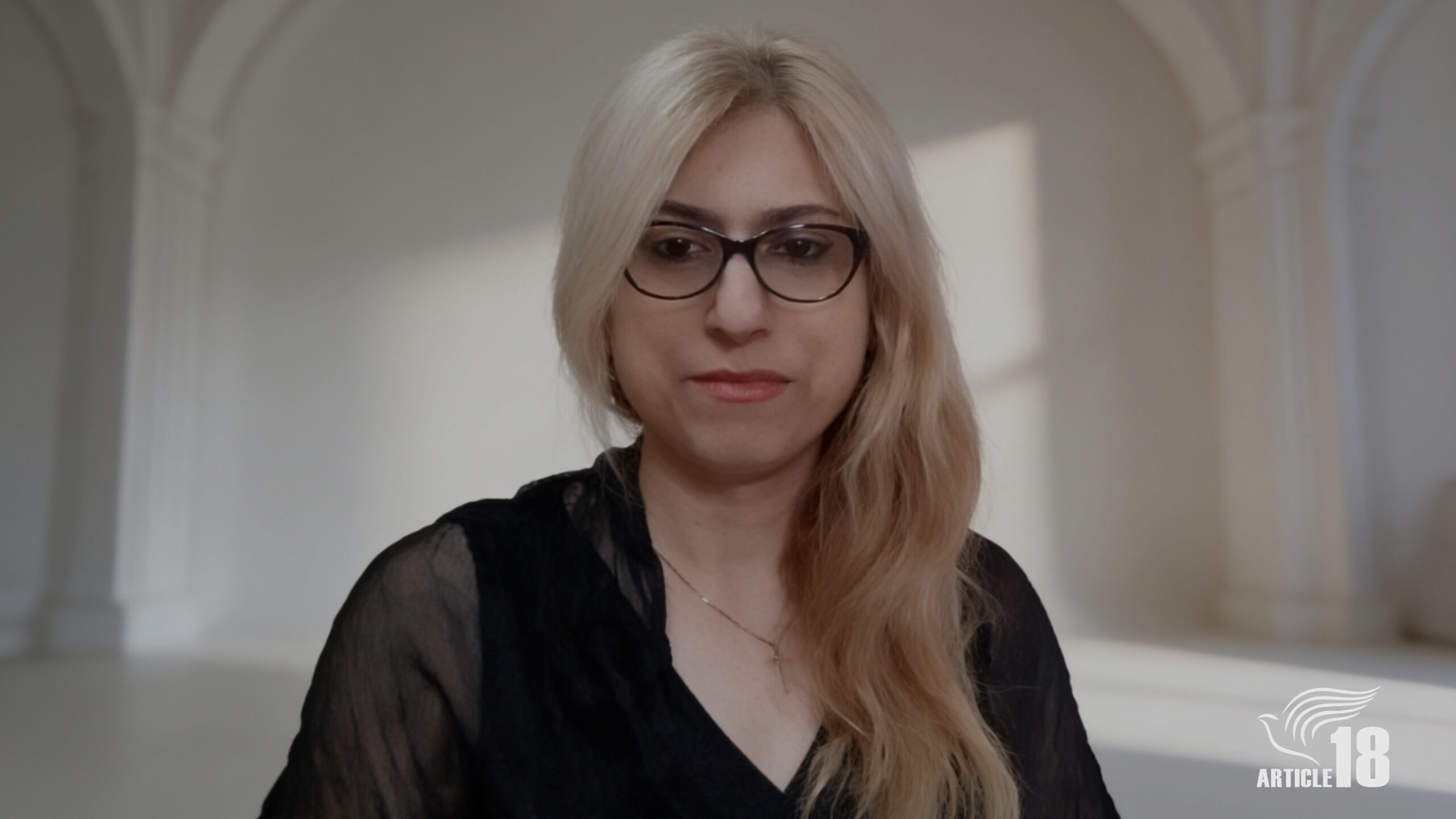
A Catholic convert serving a sentence of over nine years in Evin Prison on charges of “propaganda against the state” and “gathering and collusion against national security” has written a moving letter, reporting having been raped in a Ministry of Intelligence detention centre.
In the letter, published by Persian-language news agency HRANA, Ghazal Marzban says the rape took place after being arrested in May 2023. Ghazal speaks of being forced to endure a further “torturous” 22 days in the same facility, after being rearrested in January 2026, fearing all the time that “the terrible incident would happen again”.
Ghazal was eventually moved to the main prison only after going without food and water for 10 days, the letter says.
You can read a full translation of Ghazal’s harrowing tale below.
Ghazal’s letter
It was 17 May, 2023, a relatively cool afternoon with mild weather, pleasant for walking in the park. It was a habit I had maintained for several years to preserve my health.
As I walked, I went over in my mind the events of the previous year and everything that had happened to all of us, the people of Iran, since 16 September 2022 [Mahsa Amini’s death]: the accounts of people’s suffering, the blood spilled in the streets, the lives unjustly taken on the path towards freedom, the anguish we had once again been forced to suppress, and the streets that still bore witness to the solidarity of the Iranian people.
I walked around the park. Gradually, my steps became firmer and faster. It was as though, with every step, I was separating myself from the world around me. The slogan ‘Woman, Life, Freedom’ could still be seen on the walls surrounding the park. There were even handwritten messages that seemed to carry the trace of the small hands of primary-school girls—young girls who had written slogans in coloured pencil.
I was absorbed in my thoughts when suddenly two men and a woman stood in front of me. I changed direction, but it seemed they really had business with me. Truthfully, I became somewhat frightened. For years, whenever people with this kind of appearance confronted me, I knew that something serious was about to happen.
The woman was wearing a chador and a face mask. After the Covid-19 pandemic, wearing masks had become normal for us, but this time the mask seemed to carry the scent of fear. I don’t know—perhaps when confronting their victims, they are more afraid than we are.
I stood there staring at them, until hearing them call my name several times brought me back to myself: “Ms Marzban, you have to come with us. You are under arrest.” I asked why, but the only response was anger and threats. I tried to resist going with them, but two more men joined them and threatened that if I did not accompany them, they would take me by force.
There were two white Samand cars. A woman, a man—both wearing masks—and I got into one of the cars, while the others got into the other. After I got into the car, they blindfolded me with my headscarf.
It was about an hour, perhaps longer—I don’t know; I had lost track of time. But I was aware that I had been arrested at around two in the afternoon. It took some time before we reached their intended destination, a place that I later, during my subsequent detention, learned was one of the Ministry of Intelligence’s operational detention facilities.
First, a young man entered my identification details into the system. Then I was taken with a woman to a room to be searched. After these procedures, which did not take very long, I was blindfolded and led to one of the rooms, where two women were present. I was told to take off all my clothes.
Until that day, I had never been detained and was unfamiliar with how these procedures worked. I became extremely anxious and kept crying and begging them to let me go. The women wearing chadors and masks told me not to worry, saying that this was standard procedure and that I had to be searched. They said that if I did as they asked, they would allow me to call my husband and tell him that I had been detained.
At their suggestion, I took off my jacket, but I was again overcome by anxiety and terror. While I was naked, they wrapped a chador around me, forcibly took me into a cell, and left me there.
I got up and looked around the cell. From an opening high up in the cell that faced into darkness, I realised that I was underground. There was a shower and a stainless-steel toilet, separated from the rest of the cell by a low wall. The air was damp and thick with dust, and my breathing became increasingly laboured.
Less than 10 minutes later, the cell door opened. This time, a tall man—perhaps around 180 centimetres—entered, speaking in a harsh voice filled with shouting and anger. His eyes were visible beneath a black hood that covered his entire face except for his eyes and mouth. His shirt hung over his trousers; he looked like the other men who dress this way when carrying out repression.
He wore a red agate ring with an inscription on it, which stood out against his entirely black clothing. From the tone of his voice, I could tell that he was a man in his 30s. He was so large and heavily built that when he entered, his body filled the entire doorway. From the moment he came in, I realised that what was happening was in no way normal.
He shouted loudly at me, ordering me to change into the two pieces of clothing he had thrown down in front of me. I was terrified. I screamed and protested with all the strength I had; it felt as though, at that moment, they were pulling the life out of my body.
I was in the state of someone trapped in absolute helplessness. I wanted to pound on the door and call for help. I did not know what was going to happen. My breathing had become heavier; it was as though I were still walking in the park, faster and faster. It felt as though everything was a dream. I could not believe it.
It was me in his hands, not in the gentle hands of my husband—a husband who, for years, had respected my boundaries and dignity even when caressing or kissing me. For a moment, I came back to myself: no, this was real. I was still trapped in that room with that man. He had violated the boundaries of my body—the boundaries of my womanhood, my human dignity. My resistance, my tears, my screams…
Time felt like years to me. I do not know how long—perhaps half an hour, perhaps less or more—this brutal rape lasted. Afterwards, I was left alone, lying on the floor. The floor of a room that had turned red with the large stain of blood from my body.
I thought of all those whose names and memories live on, whose precious blood had been spilled on the streets the previous year—the very people whose most basic demand had been an ordinary life.
Less than five minutes later, the door opened again. Two women wearing masks and chadors, along with another woman dressed in white like a nurse, came over to me. They attended briefly to my distressed condition and allowed me to put my own clothes back on. They had even brought me my jacket.
Several more men from the same group entered the cell and promised that I would be released by that evening in exchange for my promise to remain silent. I wrapped my arms around my knees and sat in a corner of the cell, waiting. I had completely lost track of time. Throughout it all, I felt as though I was dreaming, but the pain in my body—and the pain in my soul, which was even greater than the physical pain—kept reminding me: “You are awake. You are awake.”
Those people returned, blindfolded me again, and put me into the same car in which they had brought me there. Throughout the journey, I was repeatedly threatened and warned about the consequences of breaking my silence. They dropped me off somewhere near my home. It was still 17 May, around 7pm.
My mobile phone had rung several times. My husband was worried because he had not heard from me for such a long time. I called him and told him that I had extended my walking route and had forgotten to take my phone off silent mode.
I returned home. Nothing felt normal to me anymore. I did not know what to do with the suffering that had been inflicted upon me.
I was worried about my husband. He had been suffering from advanced Parkinson’s disease for several years, and his condition was very poor. I did not know what learning about such an incident would do to him. The suffering caused by his illness had crushed his youth like a flower plucked from its stem, and it did not seem right to add another burden of suffering to it.
I remained silent. I became isolated and distanced myself from people. I stopped going to the park. I made the excuse that the weather was unsuitable for walking. Night and day, I held my soul in my arms, searching for healing from the unbelievable experience I had endured.
On 14 January 2026, at around midnight, I was arrested again. This time it was similar to the previous occasion, except that many sisters were with me; perhaps their presence, and the large number of people being detained, somewhat reduced my anxiety that the same thing might happen again.
This time, I was again taken to the same place. The greatest torture I endured during the 22 days I was held at the Ministry of Intelligence detention facility was the fear that the terrible incident would happen again. I protested several times against men coming and going in the women’s detention facility, but I was met with harsh treatment from the officials there.
Eventually, I had no choice but to go on a hunger strike from food and water. After 10 days, when I was close to death, they transferred me to prison.
When I was arrested last year, I tried several times to formally register my complaint about the assault, but each time they refused and threatened me into silence. Now, seven months after my arrest and imprisonment, I continue to endure the bitter days and routines of prison, still suffering from anxiety triggered by seeing men.
Yet I hope that one day the seeds of our suffering will sprout and the tree of our pursuit of justice will grow strong. Through this personal account, I seek justice for the suffering that the Ministry of Intelligence has inflicted upon my life. Perhaps I can also help spread and multiply courage, so that we may speak openly about such injustices, which prevail in the dark chambers of oppression of the Islamic Republic.
I remain hopeful for the day when my country will be freed from the violence of authoritarianism—particularly the religious authoritarianism against which women have for years constituted a major part of the struggle on the front lines. For years, through civil activism and the battle of ideas in universities, think-tanks, and gatherings devoted to justice, as well as through acts of civil disobedience, women have multiplied courage and brought about victories.
We have proved that our power to prevail is greater than the power of missiles and bombs used for domination and subjugation. We are the ones who brought protest from our homes into the streets.
We will return once again to the front-line of the struggle of ideas, until the day when freedom of thought, freedom of belief, freedom to choose how we dress, and liberation from authoritarianism are realised for our beloved homeland—not through an attack by an enemy, but through the resistance of us, the women and men of Iran.
Long live freedom; long live our homeland, Iran.
Ghazal Marzban, August 2026
0 Comments