This article, written by US-based lawyer Jason Ian Poblete, was first published on his Substack and is republished here with kind permission.
Some years ago, a man I once represented, an American, was put to death by the Islamic Republic of Iran. America could not save him. I begin with him because he is the reason that, when the regime recently unveiled a shrine to the Mother of God in its capital, I did not see a gesture of tolerance; I saw the eyes they paint shut.
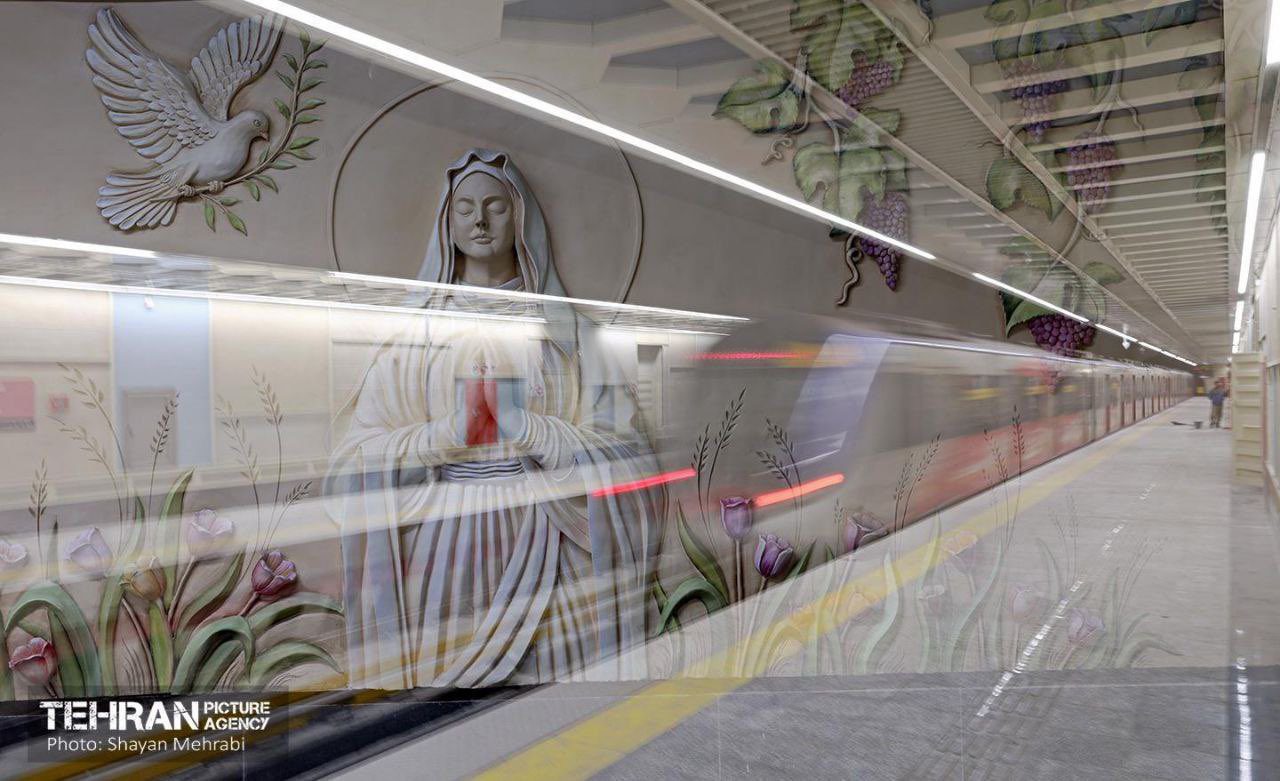
The station is called Maryam-e Moqaddas, ‘Holy Mary’. Late last November, Tehran unveiled it as an addition to its massive and growing subway system. Located close to the Armenian Cathedral of Saint Sarkis, commuters descend beneath vaulted ceilings styled after a church, past a statue of the Blessed Mother more than two metres tall, through murals of Mary and her Son set amid Persian floral motifs.
The mayor of Tehran called it a tribute to “the divine woman who awakened the world through her purity”, while other Iranian officials used the moment as a propaganda event, as “proof” of the coexistence of religions in the Islamic regime. What those officials left out of the narrative says a good deal, too. There was no mention, for instance, that the subway system itself was the brainchild of the Shah whom the regime overthrew in 1979.
We are told that the Blessed Mother is honoured in Islam, as is Jesus Christ. We are told, too, that Mary is named more often in the Quran than in the New Testament, and that an entire chapter of the Quran bears her name. Some experts hold that for a Shia state to raise what it calls a shrine to Maryam is not, on its face, a contradiction; and to a certain extent I suppose they are right. The Armenians, whose cathedral stands beside the station and whose community helped shape it, are an ancient and recognised Christian people in Iran, with their own, albeit tokenised, seat in parliament. So far, the picture is one a tourist might carry home: a tolerant Persia, at ease with the Mother of God and with the largest religion in the world.
But one modern subway station is not a mirror of the Christian faith, or of a society. It shows you what the Islamic regime wishes to be seen as; it tells you nothing of how that system acts once the cameras are gone and the commuters have passed through the turnstiles. And here the Church’s own eyes in Iran saw something a tourist would miss. Cardinal Dominique Mathieu, the Latin archbishop of Tehran-Isfahan, wrote of the station’s murals that Mary and Jesus are depicted with their eyes closed, without pupils. There is no exchange of glances, he observed, except that of the eye of the dove. The Holy Spirit, hovering above, is the only figure in the scene permitted to look back at you.
I have thought about that image a great deal. A Mary who cannot see; a Christ who cannot meet your gaze; holiness rendered safely blind, presiding in marble over a concourse, awakening no-one. Some will call it contemplative and prayerful. Others will say it is a fitting emblem, a nod of respect to Iran’s tiny Christian communities.
And there are others still, some of them my own Persian friends, who will tell you it represents the only kind of Christianity this regime will accept in its theocratic state: historic, ethnic, ornamental, and underground; out of sight and out of mind. It is the faith of the recognised minority who worship quietly in a language not their neighbours’, who do not evangelise, who do not convert, who keep their eyes closed lest the regime’s secret police catch on, grow impatient, and lock them up, sometimes in a very public way, as in the case of Ghazal Marzban.
About ten miles north of that station is Evin Prison, where Marzban keeps her eyes open. She is 42. She was a graduate of Islamic law, trained for the bar; and then she was received into the Catholic Church. For this, the Islamic regime made an example of her. She was stripped of her law license, told to leave Iran, harassed until she protested, and imprisoned for protesting. For that first offence, a court sentenced her to six months and to 74 skin-and-bone-inflaming lashes. Not one or two, but 74. Not a figure of speech, not a medieval woodcut; a sentence handed down by a functioning court in this decade, against a woman, for the crime of her conscience.
For us Catholics, there is an old patron for women like her: Catherine of Alexandria, the learned girl who confounded the emperor’s philosophers, who was scourged and imprisoned and would not recant, and whom the Church has kept for 16 centuries as the patron of lawyers. Catherine was not an attorney, but she argued with the skill of a learned advocate in defence of the faith. The Church would raise up another such advocate 12 centuries later in Saint Thomas More. Ghazal is a lawyer. Ghazal was scourged. Ghazal would not recant.
Earlier this year the regime came for her again. They took her Bible and other Christian books from her home; under interrogation they pressed her to confess that these were tools of evangelism, a crime in Iran, and she answered that they were hers, for her own use, and that as a Christian she had every right to possess them. In May, a court sentenced her to nine years and eight months. And the sentence did not fall on her alone.
Her husband is a convert as well; he suffers from Parkinson’s disease, and he had depended on Ghazal for his daily care. Her arrest took from him, in a single stroke, both his nurse and his medicine, for the treatment he requires has been withheld. She is behind the walls; he is failing outside them, and alone. As those who know the case have said, hers is a sentence for two. This was done publicly, in plain sight and with eyes wide open, to send a message to Iran’s persecuted Christian communities.
This is how the state that built the shrine actually treats the living image of what the shrine depicts: not the painted Mary with her eyes closed, but the woman who took Mary’s Son as her Lord and would not look away. We are told, rightly, that we should not judge a people by the monuments they raise. We should judge instead by how they act; by how they treat the least protected among them; and by whether they do it once, in a passion of cruelty, or, as here, repeatedly, deliberately, with medieval lashings, public humiliation, and years. By that measure, the truth about Christianity in Iran is not written on the walls of a subway station. It is written on Ghazal Marzban’s body, and on her husband’s.
The eyes of Mary and her Son are closed on that mural; but the eye of the dove is open. The Holy Spirit, in the regime’s own monument, still sees. You may render holiness blind in marble; you cannot blind the truth. That, I think, is the summons hidden in all of this. We can never hide from the truth; and neither, in decency, should we look away from it.
I write first to my fellow Catholics, and to all Christians, with a plea that is simple and old: pray. Pray for Ghazal’s release; pray for the safety of her husband and her family; pray for the persecuted Church across the Islamic Republic, those small and mostly hidden people who have kept the faith in that land since before Islam came to it. That is the first thing, and for a Christian it is never the least thing.
I will say a harder word, too, to American Catholics and Christians in particular, and to the influencers among us who have lately taken to sugarcoating this regime, softening it, waving away its record as so much propaganda. The Islamic Republic of Iran is not a safe place for Christians, Zoroastrians, or any other faith tradition beyond Islam. Not one bit. A subway station does not change that; it is built to make you believe it, and you should not.
The political future of Iran belongs to the people of Iran. And while I am not a particularly enthusiastic supporter of war with that country, having yet to hear a cogent argument from American policymakers for why we should sacrifice more blood and treasure towards a plan that would leave the regime in power, Ghazal Marzban’s case, and others like it, are a visible reminder of the danger the Islamic regime poses; the more so if responsible Christian nations fail to check the spread of Sharia practices, including here in America.
So the case of Ghazal Marzban should be not only a Christian concern but an American one, to the marrow. The people who suffer in places like Iran look towards America; not always, and not chiefly, because they want us to come and liberate them, but because they want someone, somewhere, to keep their suffering in view and to say so plainly. If we truly believe what America has fought for since its founding more than two centuries ago, that the rights we hold are not the gifts of any government but the universal endowment of every human person, then to speak for a persecuted woman in a cell in Evin is not a charity we may extend or withhold; it is the core of what we claim to be.
Bishop Athanasius Schneider, who was born into the persecuted underground Church of the Soviet Union, has called it “one of the greatest graces of my life that I grew up in the persecuted Church”. I have met many Iranians over the years in America who would understand what he says; in their own ways they long for their ancestral homeland to be free, and they are united in having come out stronger for what they and their forebears suffered under that regime.
Suffering of that kind does not destroy a people; it tempers them. The connection between America and the Iranian people is real, and our place in that longing will endure because of them; some have made the ultimate sacrifice towards it, the man I began with among them. Look at Ghazal Marzban, and pray for her and her husband. She has kept her eyes open, like the dove on that mural, when closing them would have freed her. America should keep its eyes open too; for what happens in places such as Iran, sooner or later, has a way of finding us right here in our homeland.

0 Comments