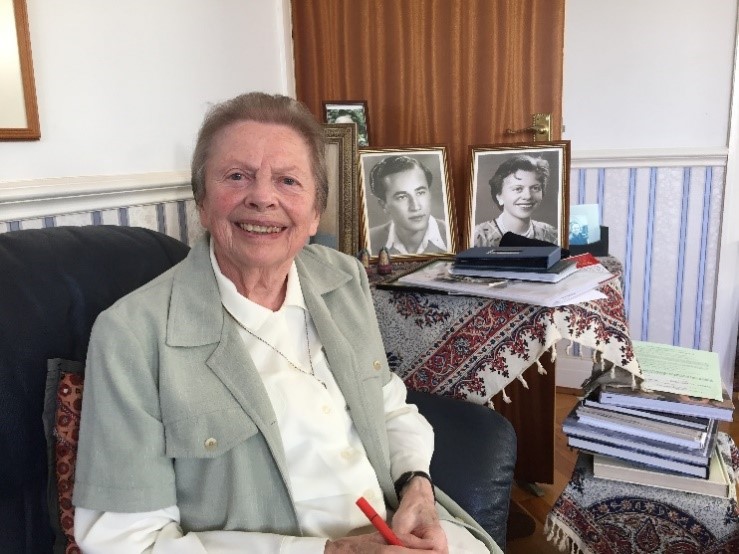
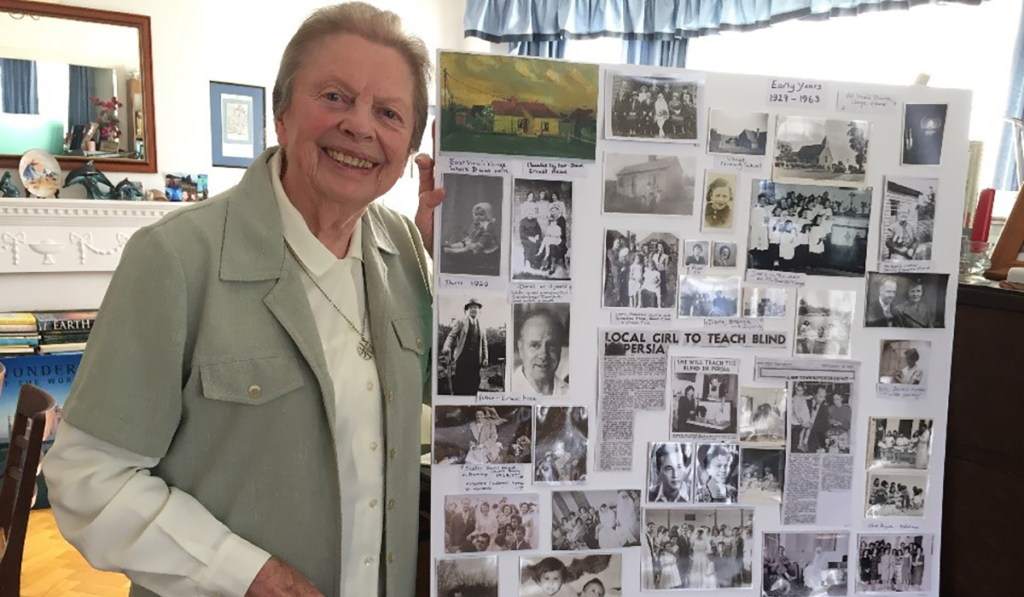
Doris Sadeghi, who died last year aged 95, travelled to Iran in 1955 to join the Ernst Christoffel school for the blind in Isfahan, and ended up staying for over 20 years.
Below are some extracts from an interview she gave with the Christian Blind Mission (CBM), which Pastor Christoffel founded, in which she retells some of her experiences. The quotes and photographs were first published on CBM’s website and are republished here with kind permission.
Aiming for Malaya, ending in Iran
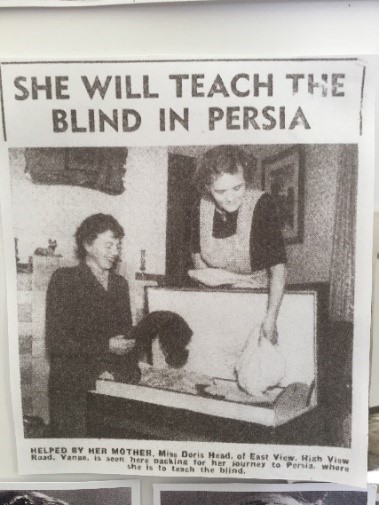
“I was supposed to be going out to a school in Malaya, working with Chinese blind children, so I was also learning Cantonese. I went brightly into the office of the United Society for the Propagation of the Gospel (USPG) and said to them, ‘I’m all ready to go!’ but they then told me that there had been a political uprising in Malaya and it could be years before I could go there.
“I stood and looked at the traffic going by in London and thought, ‘After all these years of preparation, where now?’
“Within two weeks, three different people got in touch and said there was a great need in Isfahan, Iran – at the Nur Ayin Institute. The men’s and boys’ section of the work had enough people working there but there was a lady called Gwen Gaster from the Church Missionary Society, working with the girls, women and younger boys. She was struggling on her own. They said that I was just right for this work as I had done all the training already. I met the Bishop of Iran’s wife, Mrs Meg Thompson. We had a cream tea in Fleet Street and talked. It all happened so quickly. I was ready so I just went!”
Over the mountains to Isfahan
“The wife of one of the English doctors working in Isfahan was also travelling with their two children to Iran. We were nine weeks on the journey in a freight steamer from Tilbury, Essex through the Mediterranean, down the Red Sea, out into the Indian Ocean and along the Persian Gulf. We arrived in the South of Iran and then Doctor Wild met us with his Land Rover and drove us over the mountains to Isfahan.
“We arrived on 31st March 1955. As soon as I got there, I felt completely at home in Iran. I don’t know how it was but I just loved it all.”
Meeting Mr Sadeghi
“The day that I arrived in Iran in 1955 was the Persian New Year so everybody was on holiday. When we arrived in Isfahan, a young man came to let us into the Diocesan compound. He had been playing volleyball. He was actually the first person I met in Isfahan. He would be my Persian-language teacher and eventually my husband – we were married for 52 years! He had offered to teach me Persian in exchange for English lessons, as Nur Ayin Institute couldn’t really afford to pay for lessons for me.
“There was barely enough money to keep everything going. At one point, I was sent to Tehran to speak at various organisations to raise money for Nur Ayin.”
Nur Ayin Institute for the Blind
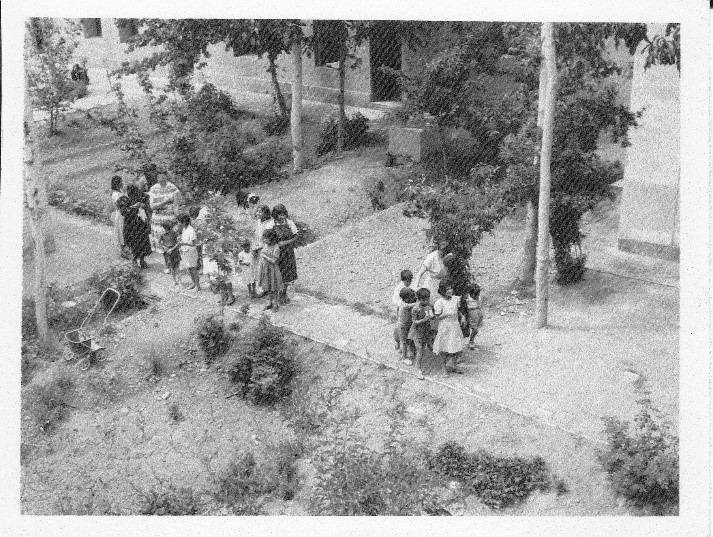
“Nur Ayin was attached to the Anglican Diocese of Iran. Within the secure compound were the Bishop’s House, the Hospital, the Church, a big hall, some residences, the nurses’ quarters and also Nur Ayin.
“Pastor Christoffel had gone out to Iran before the war and started the work there, teaching and training blind men and boys.
“However, because he was German he was interned during the War as Iran was helping the British. After the War, he re-established his work. The Anglican Diocese later appealed for someone to come and help the women and children – a little group of blind people with no care at all. Gwen Gaster took on that work on her own at first and later with help from Dorothy Shillaker, who had previously been working in Abadan.
“Pastor Christoffel’s work was with the older boys from the age of 11 or 12 and the men, teaching them all sorts of practical skills, farming and, of course, how to read and write in Braille. In that first fortnight, I was taken to see the men’s and boys’ work so I did actually meet Pastor Christoffel.
“I joined Gwen working with the women and children. I can’t tell you how many children there were. Some were very small children. Sometimes small blind children were found just lying in a gutter. Poor people would use them for begging because the more pitiful they looked, the more money they brought in as it touched people’s hearts. It was sometimes very difficult to persuade people to allow their child to come to the Institute and to let them be part of the education and the social care there. This was extremely difficult to come to terms with but you realised that this was a totally different culture there at that time. Blindness, deafness, physical disabilities of any kind were thought to be punishment from God so the families were ashamed. Any disabled child would not be sent to school or be seen very much outside the home.”
Life at Nur Ayin
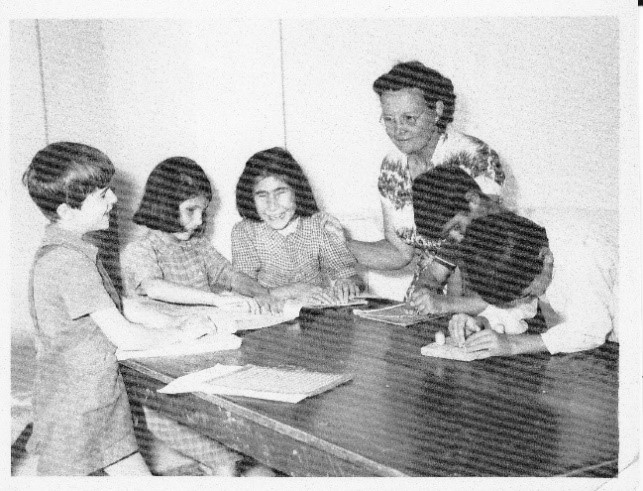
“We had little ones, aged about a year and a half, right up to the older ladies who had been together in a small group for many years. They all helped in looking after each other – the older ones looked after the little ones and they worked very hard. It was such an interesting caring situation. There were some people with sight who were paid to help with cleaning and cooking meals. There was a lot of hustle and bustle. The buildings had a sort of overhang to keep out the sun and there was a long veranda in front of the windows and doors of the rooms. Sometimes we had to be very careful walking round because some of the boys, totally blind, would ride their bikes round the corners of these verandas. They had an amazing acoustic sense of where they were and when to turn the corners. I couldn’t get over their skill and courage.
“Each day the older women and some employed helpers would get the children ready. We would be together for breakfast times and morning prayers and then get ready for lessons. Groups of the children of different ages would come for different things – Braille, Maths, music notation or weaving. We also had to keep an eye on the ones too young for school. They had a nursery group.
“All the Nur Ayin family who were able, were learning reading and writing in Braille. All were getting used to both Persian and English.
The students sang a lot and they danced a lot, too. The children were very cheeky when I was learning Persian. They helped me to learn a lot because they would tell me and sometimes roared with laughter when I made mistakes, whereas others sometimes would not mention my mistakes! It was a delightful atmosphere to be in and to live in. There was an old piano there and some of them learnt to play by ear and to others I was able to teach some Braille music notation as well.
“As they progressed in their education, those of primary school age attended the Diocesan Mission Primary School (Rahmat School) part time. Gradually, over the years their educational level grew and some of them went on to university. One of them became a famous singer on television and another one eventually became a barrister. One of the girls actually came over to the UK and became a social worker for the blind in Scotland. Some of them just stayed. Nur Ayin was their home. Some were too old to study or to learn any kind of work, some others had disabilities or were not of a mental level to be able to do as much as the others as well as having a lack of sight. One of the women, Mahboubeh, was totally blind and totally deaf but was fully accepted by everyone. They were all lovely happy family members.
“Activities were not just lessons. There was a lot that was needed, such as talking about many aspects of life and giving children confidence. Many of them still had a feeling that all this that they were being given could be taken away from them, especially if they were naughty. I remember one little girl – if she was naughty, she would go and hide under her bed. We would go and find her and as we brought her out she would say, ‘Don’t put me out in the koucheh (street).’ That was where she had been found, just wandering, abandoned, with no-one looking after her at all. We had to reassure her and others like her.”
Royal visits
“Nur Ayin’s work with women and children was of a kind that had never been seen before in Iran. It happened that in 1961, during those first years that I was there, Queen Elizabeth II and Prince Philip came to see us, brought there by the Shah and Empress Farah during a State Visit. Sometime after that, Princess Margaret and Lord Snowdon came to Isfahan and I actually sat and talked with her for about a quarter of an hour because I was about the same age and she called me over. Princess Alexandra and Lord Ogilvie also visited Isfahan and we met them. Suddenly, the work had become famous. After that, the Shah’s sister, Princess Ashraf, gave a lot of her own money to begin to finance the training of Iranian teachers of the blind. That has now developed into a Blind Welfare systems throughout Iran.
“Later, I went on to become Head Teacher of Rahmat School, the Diocesan Primary School in Isfahan, and we were able to have blind children come over for half-a-day to study in class with sighted children. The rest of the day they carried out activities in Nur Ayin. Then, gradually, children with other disabilities started to attend the school. It was the first time that anything like that had ever happened in Iran.”
Pastor Christoffel’s death
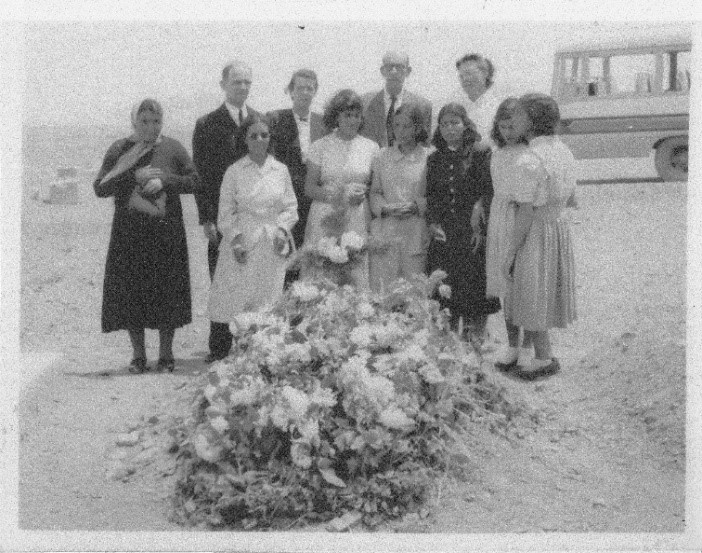
“Pastor Christoffel became ill very shortly after I arrived in Isfahan in late March 1955 and he went into hospital. I was able to go with Gwen Gaster to the hospital to see him. Unfortunately, he died on 23 April, which was just literally one month after I arrived so I did not know him well but I certainly knew his work and, of course, met people who knew him so well.
“People were obviously very sad at his death. He was very elderly and as he had been ill, I think in a way it was not so unexpected because of his age. He was very much respected and very much missed.
Pastor Christoffel’s legacy
“Before Pastor Christoffel there had been literally no education or care for blind people in Iran but after his work people heard and recognised that this was something that could be done.
“When thousands were blinded by Saddam Hossein’s chemical weapons in the war with Iraq (1980-1988), the work that Pastor Christoffel had started and that Nur Ayin had established since then, had been developed and extended so there was help awaiting those who were blind or who were tragically blinded in the war.
“What Pastor Christoffel did was pioneering work that was shown to be practical in Iran and has now spread throughout the whole world. I am sure that what Pastor Christoffel started and the type of work that has spread to other countries around the world has also become an example there and in that way has continued to spread.”
0 Comments