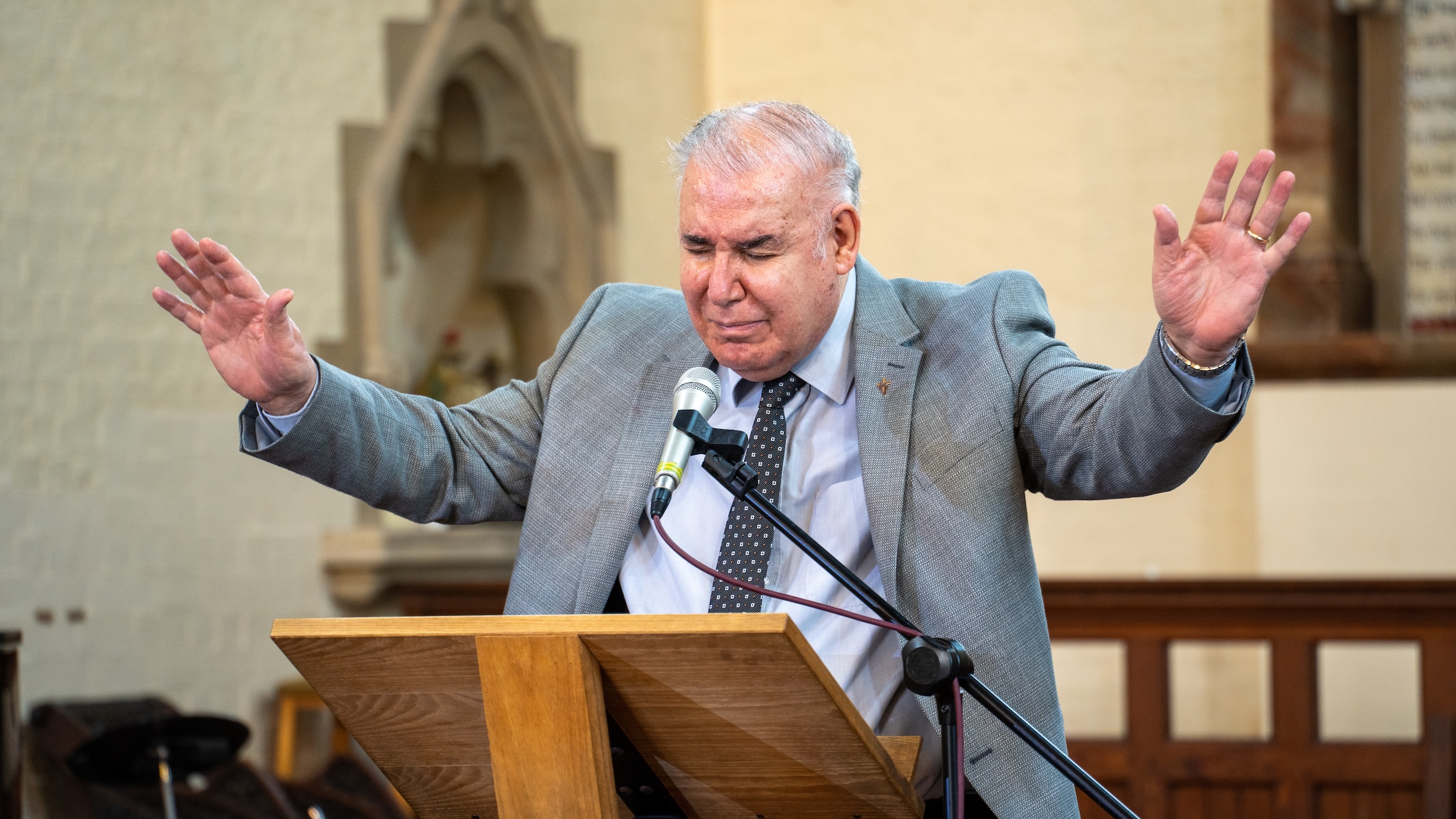
This obituary was first published by The Times newspaper and is republished here with kind permission.
Ignoring an ultimatum to stop converting Iranian Muslims to Christianity, Edward Hovsepian-Mehr continued to preside over one of the fastest-growing churches in the world.
Memories of identifying the bloodied body of his elder brother, Haik, a bishop who was found murdered in 1994 after refusing to comply with a list of restrictions demanded by the Iranian state, did not deter “Brother Edward”, as he was known.
The brothers, of Armenian heritage, had spent decades building up the Iranian branch of the Pentecostal Assemblies of God, but by the mid-1990s it was clear that public worship of non-state sanctioned Christianity in Iran was no longer viable and the church would have to go underground.
From the mid-1990s until he was forced into exile in London in 2003, Hovsepian-Mehr helped to set up house churches throughout Iran, at which small groups would meet to study the Bible, pray and sing hymns. Meetings would keep changing from house to house to lessen the chance of being raided, and worshippers would stagger their entry over a few hours so as not to attract suspicion. Most heartbreaking of all for Hovsepian-Mehr, who would belt out hymns with a fine baritone voice, was that the praise and worship had to be low volume.
As he orchestrated the secret gatherings, he was subjected to relentless harassment, intimidation, threats and repeated interrogations. Operating from London from 2003 he continued to organise pastoral support for Christian converts in Iran.
Edward Hovsepian-Mehr was born in Tehran in 1950 into a poor family of Armenian heritage. His father, Nazaar Hovsepian, a cook, and mother, Tamar Khachiki, divorced when he was little. He and his brother were brought up by their mother, who was nominally Christian. The early years were tinged by sadness, but Hovsepian-Mehr’s life changed at the age of 13 when he was invited to hear Pastor Leon Hairapetian preach. When the pastor asked, “Who among you would like to give his life to Jesus tonight?”, Hovsepian-Mehr found himself standing up. He preached his first sermon aged 16 and after completing his theological studies was ordained as a pastor at the age of 17. Aged 20 he was appointed pastor of the Assemblies of God church in Isfahan and later moved to the city of Urmia in the northwest of the country, where he planted a new church and trained new leaders.
Persecution of Christians started almost immediately after the Iranian revolution when the Anglican Pastor Arastoo Sayyah was murdered at his church office in Shiraz on February 19, 1979. Over the next few years the hard-line theocratic regime would make it clear that it would tolerate only ancient Christian communities, such as the 200,000-strong Armenian Apostolic Church and the Assyrian Church of the East, provided they conducted services in their own language and did not evangelise to Muslims.
In 1986 Hovsepian-Mehr was appointed senior pastor of the Assembly of God church in Tehran, the largest Protestant church in Iran, working closely with his brother, Haik. Both refused to bow to tighter regulation on the church and persecution intensified in the early 1990s. Iran’s Bible Society was closed down and Farsi translations of the Bible banned. Conducting church services in Farsi was outlawed and it was decreed that all church members must give their names and addresses to the authorities and people could go to church only if they were issued with an official identity card.
After the murder of Haik in 1994, Hovsepian-Mehr succeeded him as superintendent of the Assemblies of God churches in Iran, although he had to assume the role unofficially as the authorities would not recognise him. Thereafter it was difficult to travel around the country because of the threat of abduction.
At least eight Christian leaders in Iran have died for their faith since the revolution. In 1996 Mohammad Bagher Yusefi, known as Pastor Ravanbakhsh (which means soul giver in Farsi), was found hanged. Eight years before, he had converted from Islam to Christianity and ran the Assemblies of God church in Gorgan, northern Iran. His murder by state operatives convinced Hovsepian-Mehr to accelerate the house church movement, training and mentoring house church leaders.
After moving to London in 2003, Hovsepian-Mehr ran three churches, including founding a church in Finchley, the North London Iranian Church, that would become the largest Iranian church of the global diaspora.
In 2008 Iran attempted to enshrine the death penalty for “apostasy” into civil law — in line with sharia — but the state withdrew the proposal under international diplomatic pressure. Anyone found to have converted from Islam to Christianity could still be imprisoned for five to 15 years and banned from applying for jobs.
Hovsepian-Mehr mustered the support of 99 Iranian churches around the world to unite against proposed amendments to Iran’s Islamic Penal Code. He was also the principal founder of the Hamgaam Council of United Iranian Churches, a partnership of Farsi-speaking churches across Europe and Canada that connected more than 20 churches in many denominations.
“There was a lot of distrust before,” said Mansour Borji, the executive director of Article18, a London-based Iranian Christian human rights organisation. “He broke through those barriers through making people sit together and eat together.”
A hulking figure with a booming voice and beetling brows, Hovsepian-Mehr preached sermons to Iranians around the world on the satellite channel SAT-7 PARS, using the lyricism of the Farsi language. Any newcomers to his churches would sometimes be taken aback by his demand to visit their houses, without waiting to be invited. “People would think that there is something wrong, but it was just his desire to get to know them and their families,” Borji said. “Word got around that he loved ice cream.”
Yet supporting house churches in Iran remained a priority and he kept in touch with more than 200 house church leaders, running Bible study groups with them and providing training. He intensified his efforts after the Islamic Revolutionary Courts closed down the Assemblies of God church in 2013. The three remaining Anglican churches in Iran, St Luke in Isfahan, Simon the Zealot in Shiraz and St Paul’s in Tehran, have been closed since the Covid-19 pandemic.
Article18 said it was in possession of judgments issued by the Revolutionary Courts that criminalised Christians “simply for maintaining contact with Pastor Edward or participating in pastoral ministry connected to him and the house church movement”. It added: “These court verdicts stand as an unintended testimony to the remarkable effectiveness and enduring impact of his ministry.”
Hovsepian-Mehr’s first wife, Anahid, died of cancer in 2001. He is survived by their four children, Rozita, Anita, Tali and Hovan.
In 2003 Hovsepian-Mehr married Nasli. She had a daughter, Ava, from a previous marriage and they adopted a daughter, Lydia. Coming from a musical family, Hovsepian-Mehr loved to sing and play the piano, translating a number of well-known hymns into Farsi. All his children played an instrument and family occasions never failed to break into song.
The only other thing that rivalled his passion for ministry was football, but when it came to the recent World Cup he supported Brazil. It broke his heart not to support Iran, whose national team was, he said, an instrument of propaganda. Over 6ft tall, he loved to play alongside young adults in the church community. “You didn’t want to be on the team against him,” Borji said.
Hovsepian-Mehr was intending to retire at the end of this year. Walking with the aid of a Zimmer frame and working on completing his fourth book, he was present at the Palace of Westminster when Article18’s latest report was presented this year. Article18 claims that, after mass protests against the Iranian regime and the 12-day war with Israel in June 2025, Christians were “scapegoated”.
Nearly twice as many Christians were arrested on charges related to their religious beliefs or activities in 2025 than in the previous year — 254 compared with 139. More than twice as many served sentences of imprisonment, exile or forced labour and at least 11 Christians received prison sentences of ten years or more in 2025.
However, despite continued aggressive crackdowns, the underground church in Iran continues to grow. It is estimated to have 800,000 adherents. “Levels of oppression have become so much people feel there is nothing to lose,” Borji said. The example of Hovsepian-Mehr inspired many of them.
“It was because of his humility that he could take on any challenge because he knew it was God who started the work,” Charles Gogbashian, pastor of the Armenian church in Chiswick, west London, said. “He knew that whatever God had started he would finish.”
The Rev Edward Hovsepian-Mehr, Iranian pastor, was born on May 9, 1950. He died of a heart attack on June 26, 2026, aged 76.
0 Comments