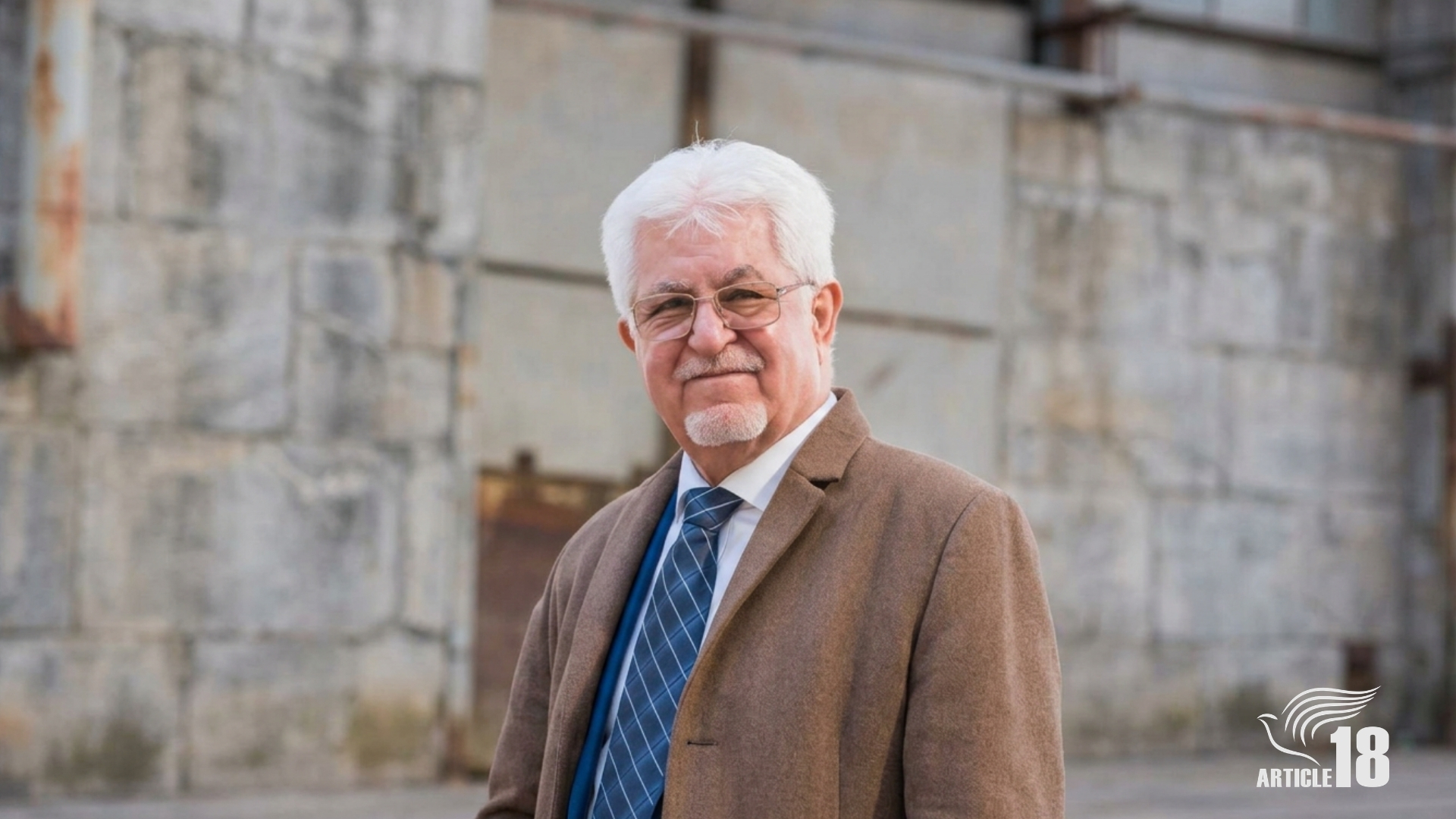
Iranian-Assyrian pastor Victor Bet-Tamraz used to lead a Persian-speaking church in Tehran, until the church was forbidden from holding services in the national language, or allowing converts to enter.
The year was 2009, when the pressure on Persian-speaking churches in Iran was at its height.
Today, no such churches remain.
But for Victor, this was not the end of his Christian leadership in Iran; only the start of a new chapter.
“I can truly say that this was the moment I entered the underground Church,” he explains. “We decided to continue our worship services and Bible studies in our home.”
It was a decision that had severe consequences.
Five years later, during a Christmas celebration in the Bet-Tamraz family home – at which were present both Christian converts and those of Assyrian or Armenian descent – some 70 armed agents raided the celebration and arrested the pastor and two of the converts.
They were later sentenced to 10 years each in prison, a sentence confirmed to Victor long before his trial took place, both by his interrogators and the judge.
“Their biggest problem and anger came from why I had, as they would say, ‘stubbornly resisted’ their threats for 25 years and served among Persian-speakers,” he says. “During the interrogations, they said: ‘You’ll get 10 years in prison for this!’”
Later on, in court, when Victor asked what “national-security offence” he should defend himself against, notorious Revolutionary Court judge Mashallah Ahmadzadeh responded: “You’ll understand when I issue your 10-year prison sentence!”
His lawyer, Shima Ghosheh, who was arrested earlier this year in relation to her work, protested that a judge “cannot issue a verdict without hearing us in court”, but, according to Victor, “the judge didn’t listen to anyone”.
“I think the hearing lasted no more than about 40 or 50 seconds,” he said. “Even the trials during Hitler’s time, which lasted two minutes, were better than mine.”
Assyrian and Armenian Christians in Iran – Christians like the Bet-Tamraz family – are among Iran’s recognised religious minority groups, and often used as evidence of purported religious diversity and freedom in Iran.
“The Ministry of Religious Affairs invites ordained ministers to various events on occasions such as the anniversary of the revolution, or Ayatollah Khomeini’s death, when members of religious minorities are invited to go to his tomb and lay flowers,” Victor explained. “The goal of the Ministry of Religious Affairs is to falsely advertise that there is freedom of religion in Iran. In fact, they are taking advantage of minorities.”
And while on the surface, such groups appear to be afforded some freedoms, they are tightly controlled.
“The pressure on us was exerted through an institution called the Department of Religious Minorities,” Victor explains, “which ostensibly operates under the supervision of the Ministry of Culture and Islamic Guidance, but in reality has no connection with it and is managed directly by the Ministry of Intelligence.
“In this department, they work with the different religious-minority groups, such as Assyrians, Armenians, Zoroastrians, and so on. And for each group, they have their own separate experts, and they would invite us to different places for questioning.
“Eventually, they ordered that our meetings shouldn’t be held in Persian, that we weren’t allowed to teach Christian doctrine in Persian or have Christian texts, articles or the Bible in Persian, or pray in Persian. And we weren’t to allow Muslims to enter the church.”
It took over three years for Victor’s appeal to be heard, but finally in 2020 his 10-year sentence was confirmed, and after his wife, Shamiram, was summoned to serve her own five-year sentence, the couple fled Iran.
But while Victor describes the journey out of Iran as “the most painful of my life”, he remains confident of the continued growth of the Church inside Iran.
“The biggest mistake the Islamic Republic made to prevent the spread of Christianity was to close down church buildings,” he says. “The truth is that this action, although unpleasant on the surface, caused the house-church movement to grow and many people to become Christians. Now, despite the hardships and persecution, the Islamic Republic can no longer stop this growth.”
You can read Victor’s full Witness Statement here.


0 Comments