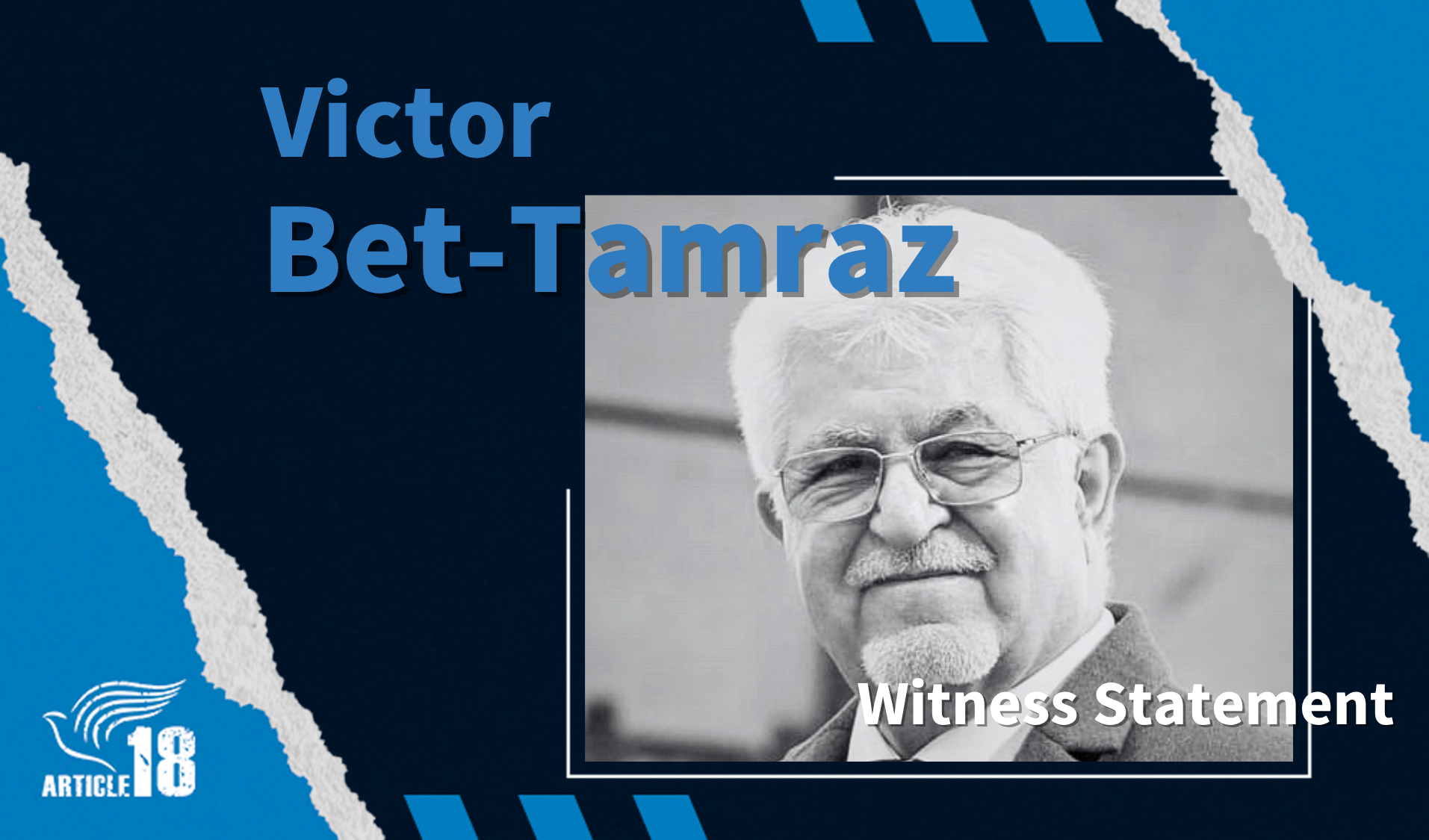
For a summary of Victor’s story, you can read our feature article here.
Background
1. My name is Victor Bet-Tamraz. I was born in the city of Urmia [northwest Iran] in 1954, and grew up in a nearby village called Digaleh. We lived in the village in the summers, but returned to Urmia in the other seasons for school.
2. My mother was a member of the Pentecostal church and her father was a minister of the Assyrian Pentecostal church in Urmia. I went to church from my childhood, and after the ups and downs of adolescence, on 21 March 1975, had an encounter with God and surrendered my life to Him. From that moment on, I began my activities in the church, especially among the youth group. About a year later, in June or July, I was baptised by Rev Edward Hovsepian [brother of Haik Hovsepian] in a river in a nearby village: Dizaj Tekye. In 1976, I did my military service, and in 1977 I went to Tehran and became part of the Pentecostal Assyrian church in the Shahr-Ara district, which had services in both the Assyrian and Persian languages.
3. In May 1979, I went to India to study theology, and after four years received a bachelor’s degree. I met my wife, Shamiram, in my second year in India, and we married in 1981. She was studying for her master’s degree in theology, having already received a bachelor’s degree in English translation.
4. We returned to Iran in late 1984, and both of our children were born in Tehran. Our first child, Ramiel, was born in 1984, and our daughter, Dabrina, was born in 1985. Their age difference is about 14 months.
Church leadership
5. I began leading the Shahr-Ara Church after I returned from India, and I also attended house-church meetings in the home of Shamiram’s father. Shamiram and I had both studied theology, so we served together at the church, whose members were a mixture of Persian-speakers, Assyrian-speakers, Armenian-speakers and Chaldeans, so we generally held one meeting a week in Assyrian and the rest in Persian.
6. In addition, we travelled to various other cities, such as Kermanshah, Hamedan and Urmia, and evangelised and taught others there, and our children accompanied us on these trips. In Kermanshah, we had a church building and meetings were held in Persian. Most of the members of this church were Persian-speaking converts.
7. In 1990, we went back to live in Urmia, and every Wednesday we would gather in the homes of different members and hold prayer meetings. There were only around 10 or 12 members at that time, and as we didn’t have a place for church services, we bought a house that had a large room, which was about 60 square metres.
8. In 1995, I handed over my role in Urmia to another church minister and my family and I moved back to Tehran and settled there.
9. After we relocated to Tehran, sometimes other leaders would come to visit us, and we would visit them in their cities. These visits helped us to grow closer to one another and serve together in harmony.
The beginning of Ministry of Intelligence pressure on churches
10. The Ministry of Religious Affairs used to invite ordained ministers to various events on occasions such as the anniversary of the revolution, or Ayatollah Khomeini’s death, when members of religious minorities would be invited to go to his tomb and lay flowers! During some of these events, which were organised by the Institute of Interfaith Dialogue, people from many different countries were present. The goal of the Ministry of Religious Affairs was to falsely advertise that there was freedom of religion in Iran. In fact, they were taking advantage of minorities.
11. At one of these events, a pastor from the United States who had been invited to attend asked me in English why they wouldn’t let me speak there. At that moment, seven people with cameras approached us, and I told him: “It’s because of these cameras!”
12. The threats began around 1985, when we formed the “Council of the Church Ministers”. The word “council” was frightening for the Islamic Republic because they themselves carried out much of their work in the form of various councils, such as the City Council and Guardian Council. They also thought that we would discuss issues in this council that could pose a threat to the survival of the Islamic Republic. They even told us we should call it an “association” and not a “council”. People from various institutions of the Islamic Republic also attended our meetings many times to spy on us.
13. In the mid-1990s, a series of murders of Christian leaders and priests occurred in Iran in an organised manner. Most of the threats, pressure and attacks targeted the members and directors of our council’s board. I joined the council after the murders of Rev Haik and Rev [Tateos] Michaelian. Edward [Hovsepian] became the president of the council, and I was his deputy.
14. The pressure on us was exerted through an institution called the Department of Religious Minorities, which ostensibly operates under the supervision of the Ministry of Culture and Islamic Guidance, but in reality has no connection with it and is managed directly by the Ministry of Intelligence. So in truth, the members of this department are representatives of the Ministry of Intelligence. In this department, they work with the different religious-minority groups, such as Assyrians, Armenians, Zoroastrians, and so on. And for each group, they have their own separate experts. They would invite us to different places, like the [five-star] Homa Hotel, for questioning. In fact, we had many confrontations and threats from this group, but we didn’t take them seriously. However, after a while, due to a lot of government pressure and some disagreements among ourselves, we were forced to dissolve the council.
15. But all the different agencies were connected and under the control and influence of the Ministry of Intelligence, and had to report their activities to them. For example, our home was in the Gisha neighbourhood of Tehran and sometimes the Gisha police station would call me and tell me the police chief wanted to see me. But then I would explain that I had seen Mr so and so at such and such an agency the day before, and they would accept this and say that therefore there was no need for a meeting, because they were connected to each other.
16. Eventually, the Department of Minorities ordered that our meetings shouldn’t be held in Persian, that we weren’t allowed to teach Christian doctrine in Persian or have Christian texts, articles or the Bible in Persian, or pray in Persian. And we weren’t to allow Muslims to enter the church. In Acts 4:29 it says: “Now, Lord, consider their threats and enable your servants to speak your word with great boldness.” This verse encouraged and strengthened my heart so that I wouldn’t be afraid or worried. My gaze was on God, the fullfiller and leader of my faith. The threats couldn’t discourage me from serving the Church.
17. Their custom was that they didn’t call me “Reverend”, but only by my first or last name. They told me: “Victor, a Paykan car might be driving along the road when suddenly a lorry might crash into it. You have a Paykan car, right? Or they’d say that: “A motorcycle might crash into someone and that person may die on the spot, but the person responsible won’t be found.” Or “A person might get into their car and suddenly find the brakes aren’t working.” Or “Their child might get lost and they might not be able to find them.” Alongside these threats, I also knew that for a while my phone had been tapped, so I used other people’s SIM cards, or public phones.
18. While we were still living in Urmia, some of our son’s classmates disappeared and were never found. We were from the Assyrian community, so we were a minority and had been threatened many times by the Ministry of Intelligence. When my son was about 11 years old, he was late coming home, so I went to look for him. When I found him, a Paykan Deluxe car whose number plate was covered over with mud had stopped next to my son, but after my son pointed at me, they put the car in reverse gear and drove away. When I asked my son about what had happened, he told me they had said: “Come sit in the car, take us to a particular place, and we’ll bring you back afterwards.”
19. The threats started to become much more obvious and public in around 2009, and there was a lot of pressure from the Ministry of Intelligence on me and my family, but I still didn’t really take their threats seriously and didn’t mention them to my family and church members, so as not to cause unnecessary fear and panic.
20. At one point, they asked me to write down the names of our church members, and I knew that after this, they would also ask for their national ID cards. They also wanted to know how many had been baptised. I didn’t want to endanger the church members, or for court cases to be filed against them, so I refused to comply. But the Assemblies of God Church in Tehran gave them a list of the names of a large number of members, and some of the members presented their national ID cards and cases were filed against them. Anyway, they sent their agents to our churches and recorded the sermons and filmed the meetings, so they already knew our members.
21. We taught the church members about persecution and that those who follow Jesus Christ should expect difficulties and persecution, but that we must follow Him and be prepared to face persecution. The book of Acts is the best lesson for Christians in Iran. I resisted the authorities’ demands for years. The Ministry of Intelligence responded by raiding the Kermanshah church and closing it because only Persian-speakers had been present.
Church closure and starting a house-church
22. The Assyrians in Iran have four denominations: the Assyrian Catholic Church, Church of the East, Assyrian Evangelical Church, and Assyrian Pentecostal Church. All the religious activities of the Assyrian community were carried out by these four churches. One of the Pentecostal churches we had was in Urmia, but due to its extensive activity for Persian speakers, the Ministry of Intelligence closed it and stopped all its activities.
23. Our Shahr-Ara Church in Tehran had also been serving Persian-speaking Christians for over eight years, holding separate Friday and Sunday worship services specifically for Persian speakers. But in March 2009, the Ministry of Intelligence, with the help of the Assyrian representative in the parliament, pressured the church to either provide services only in Assyrian and for Assyrians, or else it would be closed by a ruling of the Revolutionary Court. Finally, on 31 March 2009, the church’s services in the Persian language were stopped, and I was banned from continuing to lead the church.
24. After the church was taken over and given to the East Assyrian Church, we decided to continue our worship services and Bible studies in our home. I can truly say that this was the moment I entered the underground Church. The way of working, form of services and strategies in a regular church are different from a house-church. The activities of house-churches are very extensive, and God gives those who work in them creative and necessary strategies.
25. I tried to observe security protocols, so as not to put anyone at risk. For example, I didn’t travel by plane or bus, so that my name wouldn’t be registered anywhere. Or, when I went to Kermanshah in my personal car, I didn’t use my own card to pay for the petrol but used those of friends who lived there. I tried not to leave any traces of myself. I also made appointments with church members and leaders in a new place each time. Of course, for the sake of protecting Christian friends in Iran, it is better not to recount all our methods.
26. The conditions of religious persecution in Iran have turned Christians and Christian leaders into fighters who must constantly think and plan to protect themselves and their church members. Measures that will both preserve the church and allow it to grow. With small house-church groups, great things can be done. The biggest mistake the Islamic Republic made to prevent the spread of Christianity was to close down our church buildings. The truth is that this action, although unpleasant on the surface, caused the house-church movement to grow and many people to become Christians. Now, despite the hardships and persecution, the Islamic Republic can no longer stop this growth.
27. There were many threats from the Ministry of Intelligence, but I believed that we had to stand up to them. I would argue with them wherever I was summoned, including at the Ministry of Intelligence. I once said: “You speak of the ‘tree of martyrdom’. Christianity also has a tree of martyrdom, and this tree has been watered with blood. Don’t try to scare us with your threats!” An interesting thing is that one of the interrogators once said: “We have already scared off many of your colleagues!” The fact is that after the martyrdom of Pastor Haik, some Christians became afraid and fled Iran.
Arrest
28. At Christmas, it is customary for Assyrians, as well as Armenians, in Iran to visit each other’s homes to wish each other Merry Christmas. On Christmas Day in 2014, we had house-church meetings in both the morning and afternoon. Then, the next day, Armenian, Assyrian and Persian-speaking Christians came to our home to celebrate. But at 5.30pm, plainclothes agents from the Ministry of Intelligence raided our home. There were around 30 people present, but the number of agents was much greater – in total, there were more than 70 male and female agents. The purpose of this large number was to scare us.
29. They had no warrant to show us. One of the agents asked if we had a dog at home and, when I asked why, he said: “Because Rev Vruir [Avanessian, when he was arrested] had a dog at his home, and because dogs are unclean, we entered with shoes on. So I asked to know if we should also enter your home with our shoes on.” When they realised we didn’t have a dog, they took their shoes off.
30. The agents carried guns and handcuffs. They said we had no right to talk to each other, and started their interrogations right away. They asked each and every person questions, and one of the agents took photos and videos of everyone. They also asked for everyone’s national ID cards. The last name of one of the attendees at the meeting was Shariat and the agents thought he was a relative of Pastor Hormoz Shariat [founder of a US-based satellite TV station] and was working with him. They interrogated him for about three hours, until they realised they had made a mistake. They interrogated everyone individually and then took everyone else out of the house, one by one, before interrogating me and Shamiram.
31. They seized many items from our home, including three mobile phones, family photos, bank documents and 1,000 Christian books, including various Bibles, Bible commentaries, and even some books published in Iran, such as Bibles translated by Pirouz Sayar [sanctioned by the Ministry of Islamic Guidance]. The documents they seized included our own, as well as some belonging to friends of ours who had emigrated from Iran and given us, and mainly Shamiram, power of attorney for matters related to their bank accounts, bank cards, and their homes.
32. Their behaviour was very insulting. Without a warrant, 70 agents had entered our home, taken our belongings, documents and papers without permission, and had even suggested our home was impure by asking us if we had a dog. It was a very bitter night.
33. The agents arrested me and [Christian converts] Kavian [Fallah-Mohammadi] and Amin [Afshar-Naderi]. Both our children were abroad at the time, so only my wife witnessed my arrest. After the arrest, Shamiram’s sister-in-law came to our home and stayed with her, to keep her company. I later found out that 17 or 18 other members of our church groups in different cities had also been arrested.
Prison and solitary confinement
34. It was after midnight, around 12.30am, when the agents put me in a Peugeot, without a blindfold, and took me to Evin Prison. We arrived at the prison at around 1am but had to wait for about 20 minutes to be let in because the agents didn’t have an arrest warrant. During this time, they managed to obtain a warrant. Then they blindfolded me, took me into the prison, and gave me prison clothes to wear.
35. I was taken to solitary confinement in the famous ward 209 of the prison, which is reserved for political prisoners, and my charges were considered to be political. What is evident is that followers of the Protestant branch of Christianity, when they are arrested, are considered political prisoners in Iran.
36. The cell was small, about 2.20 metres long, 1.5 metres wide, and 4 metres high. The light in the cell was always on, as were the lights on the door and in the corridor. The sound of Quranic recitations and lessons were also played continuously and loudly over the speakers. To go to the bathroom, I had to call the guard. Then, about 10 to 15 minutes later, he would come and take me to the bathroom, blindfolded.
Interrogations and torture
37. On my first morning in prison, I was taken to be charged, and that evening I had my first and briefest interrogation. To go to the bathroom, take a shower, or get some fresh air, I would be taken out of the cell, blindfolded. They also blindfolded me when they wanted to take me from the cell to the interrogation room, or back to the cell, but inside the interrogation room I wasn’t blindfolded and could see the faces of the interrogators. There were three of them, two of whom had been among the agents who came to our home the day I was arrested.
38. They wanted to know all about our church activities. They would write a long question, and I would answer briefly in one sentence, and this would make them angry. They would say I should explain more, but I would tell them I didn’t have any more to say. For example, they would ask what our house-church meetings were like, how many people attended, what I taught and how many people I taught, etc. The only thing I went into any detail about regarding Christianity was the 12-step programme of NA [Narcotics Anonymous], which was based on Christian teachings. One of the things they asked was whether I was in touch with anyone from the [outlawed] “People’s Mujahedin” organisation [MEK]. They said if I introduced them to someone from this organisation, I would be freed and acquitted. But really, they only intended to accuse me of being in contact with and cooperating with the MEK, so they could add it to my charges if I mentioned a name.
39. In prison, prisoners have to be taken care of and, if anything happens to them, the interrogators should be held accountable. That was why the quality of the food was good. Twice a week, on Sundays and Wednesdays, I was allowed to take a shower, and afterwards was given a new set of clothes. The guard in charge of the ward also gave me permission to wear socks, when I explained to him that I needed to wear them for health-related reasons.
40. They didn’t torture me physically, but they subjected me to a lot of mental and emotional torture. One of the torture techniques was that sometimes I would be interrogated for a day, and then there would be no interrogation for a few days. Then again I would be interrogated, and then not for several days. Once, they didn’t come to see me for 13 days. During this time, the only contact I had was the guard who would bring me breakfast, lunch, and dinner, and I had to spend the rest of my time alone in my cell.
41. There is a clinic in Ward 209, and a doctor would come once or twice a week to check on prisoners with health concerns. So on Thursdays I would have a check-up and they would measure my blood-sugar levels and blood pressure, and give me my medicine. I was usually allowed to get some fresh air once or twice a week. The “fresh air” area was a 4×4-metre outdoor space with wire meshing overhead. We were allowed to be there for about 15 minutes each time, and we could either walk around or sit on a chair. It was actually designed to put further pressure on prisoners, as a kind of “white torture” [because prisoners are given only a fleeting glimpse of the sky].
42. Another of their torture methods was that they changed my solitary-confinement cell almost every week. One cell was hot, one was cold; one was dirty, another clean. Each one had bad and difficult conditions, but they didn’t want me to get used to any fixed situation, and this constant change of environment was a kind of suffering and pressure in itself.
43. Usually, solitary confinement is for one week, and when a prisoner is released after that week, or transferred to a general ward, it is well understood that that person’s mental state will have been impacted. If you lock yourself in a small space at home for five hours, you can somewhat imagine the situation of those in solitary confinement. Well, I was in solitary confinement for a total of 65 days.
44. During this time, after each interrogation, I was allowed one one-minute call to my family. My brother’s wife counted my calls, and I made a total of 13, meaning I was interrogated 13 times. These conversations had to be in Persian, and just long enough to let my family know that I was OK.
45. I had read many books about Christians who had suffered in prison, such as Richard Wurmbrand’s ‘In God’s Underground’, so I was aware of the techniques and strategies of the interrogators and knew that I should expect such things in detention.
46. Another of their techniques was to use the good cop, bad cop method. But during my detention, I never agreed to cooperate with them or give them the names of Christians I knew. I didn’t want my friends to get into trouble, and that’s why my detention lasted so long.
47. The interrogators respected me because of my white hair, and generally spoke politely, but they sometimes said heavier things, and they also threatened me and my family a lot. Their biggest problem and anger came from why I had, as they would say, “stubbornly resisted” their threats for 25 years and served among Persian-speakers. During the interrogations, they said: “You’ll get 10 years in prison for this!”
48. Every time I went for interrogation, they repeated their stories. They said: “You converted many people to Christianity.” My answer was that I wasn’t the one who had converted people, and that if I had, they should be known as “Victorians”. When Jesus Christ converts people to Christianity, it has nothing to do with us.
49. Usually, when they wanted to change my solitary-confinement cell, they didn’t give an explanation or ask me; they would just say: “Bring your stuff.” Then I would have to take my towel and three blankets. I remember very clearly one time, 47 days after my arrest, when after an interrogation they told me: “Bring your things; we’re going to take you to a ‘suite’”, which was a place where you shared a room with several other detainees. And I said: “I’m not going, I want to stay here.” Because I had had enjoyable moments with Jesus Christ in solitary confinement. He said: “Then you should write in the letter that you didn’t want to go to the ‘suite’ and we’ll give it to the interrogator.”
50. When I was in prison, in difficult and hard conditions, I always felt that there was a force behind me. I believed that many Christians were praying for me, and I considered the peace I had in prison to be the result of these prayers.
51. But I remember that at one point during my detention I didn’t feel at all well for eight nights and could only sleep for around two hours a night, and would wake up every 20 minutes either from nightmares, profuse sweating, or a high heart rate. But when I explained my condition and said that I wasn’t feeling well, they only said: “Since you sleep during the day, you can’t sleep at night.” After these eight hard and stressful days, they wanted to take me in front of the camera to conduct an interview under duress, but I refused and was sent back to my cell.
52. They usually bring medicine for prisoners who need it at around 9pm, and that night, when the medicine was handed out, they said that the doctor wanted to see me. So, finally, after eight days and nights, the doctor was allowed to ask me about my condition.
53. Outside Iran, when people are arrested they have the right to a lawyer, but we weren’t even allowed to talk about this right. In fact, many lawyers, such as [Shima] Ghosheh and [Amirsalar] Davoudi, who have taken on the responsibility of representing prisoners in “security” cases, were themselves arrested for doing so.
Release
54. In total, I was in solitary confinement for 65 days and quarantine [where prisoners are held before being transferred or released] for two days. When I entered the quarantine section, there were 35 people there, but by the time I left, there were almost 70. About four or five hours after I entered quarantine, they gave me my Bible and I had a good discussion with the other prisoners about Christianity and the Bible.
55. The bail amount set for me was 300 million tomans [$110.000]. Our home, which was in both mine and my wife’s names, was valued, and Shamiram submitted her part of the deed as bail, and on 1 March 2015, I was temporarily released from prison. It was a bittersweet moment. During my detention, I had lost about nine kilos and my hair had been shaved off, so I was bald and had changed a lot. But I had also experienced the presence of Jesus Christ with me in prison.
56. When I was released, two of my brothers picked me up. But the streets suddenly seemed unfamiliar to me and I couldn’t recognise them, even though our home was in Gisha. I even asked my brother where we were and he said: “This is your neighbourhood, Gisha”. I only finally realised where I was when we passed the local pizzeria. When we got home, all the members of my extended family were waiting for me.
57. One of the things that has stayed with me from my time in detention is my reaction to the sound of the doorbell ringing. Our bell at home was broken, and when we repaired it, it sounded exactly like the bell in Ward 209. Every time I heard that sound, it would make me restless. Even now, hearing that sound bothers me. Because I remember that in the middle of the night, that bell would ring, and then the officers would go to the cell next to mine and beat the prisoner in that cell very badly. They would shout: “Hit him in the head! Hit him in the head!” Then another person would say: “He’s unconscious, what can we do to wake him up, so this won’t be reported to the higher authorities?” I couldn’t imagine what they had done to that prisoner.
58. After my release, some of the items that the agents had confiscated from our home were returned to us, but they kept some of our documents, as well as our mobile phones and family photos.
59. We later concluded that one of the members of our group had entered the church as an infiltrator and spy and played a role in our arrest, as well as the later arrest of my son. However, our main issue and conflict was with the person who had brought him to the church in the first place, though that person had also been a victim of persecution.
60. After someone is released from prison, especially in security cases, life is different. For example, some Christians were afraid to communicate with us afterwards, although others maintained their contact. To some, we were considered to be thoughtless and illogical people, while to others, we were heroes who had taken risks and stood up for our beliefs and ambitions. Most Christian prisoners, after their release, may experience loneliness and rejection from other Christians. However, along the way, we also learn not to have unreasonable expectations of others.
61. Some Christians would come to visit me after midnight so that no-one would see them. During that time, I would meet up with Pastor Vruir and two other Christians who weren’t as well known but who had also spent time in prison, and we would support each other.
Court
62. The first court session in our case was held on 11 June 2017, at Branch 26 of the Islamic Revolutionary Court of Tehran, presided over by Judge [Mashallah] Ahmadzadeh. In several court sessions, Mohammad Moghiseh, Ahmad Zargar, and Abolghasem Salavati were among the other judges hearing the case. Ahmadzadeh said that my charge was “acting against national security” and asked me to present my defence. I asked him: “Tell me what is the national-security offence that I should defend myself against!” He replied: “You’ll understand when I issue your 10-year prison sentence!”
63. My lawyer, Ms Ghosheh, said: “Mr Judge, you cannot issue a verdict without hearing us in court. That isn’t how one should judge! You say the charge is ‘acting against national security’, but for such a charge, the accused must belong to an organisation, and have the means to act in this way. What did you confiscate from these men? Did they have weapons or belong to an organisation? The only things you confiscated were Bibles and books related to Christianity.” But the judge didn’t listen to anyone. I think the hearing lasted no more than about 40 or 50 seconds. Even the trials during Hitler’s time, which lasted two minutes, were better than mine.
64. On 18 June 2017, our verdict was finally issued three years after my release. Judge Ahmadzadeh of Branch 26 of the Islamic Revolutionary Court of Tehran sentenced me to 10 years in prison and a two-year ban on leaving the country, citing Article 498 of the Islamic Penal Code, for “establishing and managing an evangelical house-church”. I wasn’t surprised, because the interrogators in prison had told me that this would be my sentence before I went to the court. I appealed and hoped that the sentence would be reduced in the appeals court. It is truly painful to be found guilty and given a heavy sentence for loving Christ, worshipping and peaceful Christian activities.
Appeal hearings
65. The entire process from the issuance of our sentence to the result of our appeal took more than two years, and this waiting period was very difficult. In the appeals court, cases are sent to a special department in the judiciary. A friend of [Yonathan] Betkolia [the Assyrian representative to the parliament] worked in that department and came there with me once and talked about my case. But he told me that since my case was ideological and security-related, he couldn’t do anything.
66. Over the course of a year, three to four appeal-court sessions would be convened, and the date of each session would be announced two months before. During those two months, we had no peace of mind and didn’t know whether the verdict would be confirmed or reduced. We always went to court on the appointed dates, and sometimes had to wait for an hour and a half for the hearing, before they would make some excuse. [Hassan] Babaei, who was the judge of the appeals court, had already told the person in charge of his office to cancel the hearing. We were being played, and didn’t know when this game would end, which was an added pressure. There is a Persian proverb that says: “The game is a game for the cat, but it’s death for the mouse.” My family and I experienced this death several times. In total, we were summoned to the appeal court 12 times.
67. Judge Babaei was later promoted and a new judge came to replace him. If this hadn’t happened, the sessions would probably have continued to be cancelled. The new judge was a respected man, who intended to acquit me, but due to their own internal conflicts, he was fired despite having a PhD in Law, and was eventually forced to work at Snap [taxi service] to make a living. According to the officials’ own statements, they had sent an inquiry to Khamenei’s office about my case, and had been told that I should be sentenced to imprisonment.
68. Finally, in early 2020, while I was at home, my lawyer called me from her office and said: “Unfortunately, your decision was confirmed, without you having to give your final defence.” Earlier that same day, before my appeal-court verdict was announced, my wife Shamiram had also been summoned to serve her own prison sentence. It was very strange that her summons was issued first and then my 10-year prison sentence was confirmed.
Family
69. My wife Shamiram is a brave and courageous woman. She and I had prepared ourselves for persecution and imprisonment. I also had complete confidence in the faith and steadfastness of both my daughter and son, when they were persecuted by the Ministry of Intelligence. My daughter, Dabrina, did very good and effective advocacy work outside of Iran during this period of persecution.
70. And my son, Ramiel, showed that he was even stronger than me in the face of persecution, and what he experienced was a great lesson for me. He even wanted to hold prayer meetings when he went to prison, but some of the prisoners told him: “Don’t involve us, because you might add another crime to our list of accusations.” However, he had fellowship with some of the foreign prisoners from African countries, and every time he called me from prison, one of those African Christian prisoners would be there with him, talking to me about Bible verses. He never showed any signs of weakness, and I am proud of him.
71. Ramiel had been arrested in August 2016, during a raid by security agents on a garden in Firoozkooh [east of Tehran], alongside 14 other young Christians who had gone there from Tehran for fun. Amin, one of the young people also arrested with me at the 2014 Christmas party, was also among those present. Ramiel was sentenced to four months in prison by Judge Ahmadzadeh. Continuing the pressure on our family, my wife Shamiram was also summoned to the Revolutionary Court in 2017 and charged. On 6 January 2018, Ahmadzadeh sentenced her to five years in prison on charges of “forming and managing house-churches, participating in Christian seminars abroad”, as well as the baseless charge of “training Christian leaders in Iran for espionage”. Several young members of our church also received heavy prison sentences for being members of a house-church, which was very painful.
Leaving Iran
72. After my arrest and temporary release, the interrogators repeatedly called me and summoned me many times to go alone to various places. Of course, I always travelled with someone else, who would wait for me nearby. In their conversations, they always insisted that it would be better for me if I left Iran. I already knew that the Islamic Republic wants active Christian to leave Iran.
73. While we were going through the legal process and waiting for the appeal court’s verdict, many friends insisted that we should leave Iran to save our lives because of the circumstances we were in, because I was 66 years old at the time. But I had no intention of leaving. For this reason, I waited those three years until the verdict came. I was ready to go to prison if the sentence was two to three years. But the 10-year sentence wasn’t easy for me to accept, and enduring 10 years in prison wouldn’t be of any benefit for anyone. My son Ramiel, who had only recently come out of prison, told me: “Dad, you weren’t in a general ward, but I was and I know what it is like there. For people who are older, it is much harder to endure those conditions.”
74. The hardest decision of my life was to leave Iran. But in the end I concluded that staying in Iran wouldn’t be beneficial for me or those around me. Maybe it would be beneficial for other Christians’ battles for a while, and they could talk about how I was an example, but maybe I could be more useful abroad and continue my battle to support Iranian Christians there. In the end, in August 2020, I was able to leave the country easily, and I consider that the fruit of prayer, because I believe it was a miracle that I could.
75. The journey out of Iran was the most painful journey of my life. It is very difficult to leave the homeland where you were born, raised, and where you have all your belongings. My belongings weren’t a house or a car; my belongings were the people I had served for 45 years in all parts of Iran. People with whom we had many memories of sharing love, sitting at each other’s tables, enjoying fellowship, and living together.
76. After this persecution, I learned how to help myself in different ways and fight the fears, worries and effects of that time. I tried not to lose my spirit and to protect myself mentally and physically. A week after we came to Switzerland, the secretary of our new church saw us on the street, and asked my daughter Dabrina in surprise: “Why aren’t your parents depressed? Why are they laughing?”
77. But really the first week after leaving Iran was very difficult. I have no particular problems physically, but emotionally I still miss seeing my loved ones, and this longing is very difficult to cope with. I remember the hope in the eyes I said goodbye to, and hope we’ll meet again one day.
0 Comments